
PSP Projects share is attracting investors because of its strong revenue growth, large order book, positive management guidance and exposure to major infrastructure and data centre projects. PSP Projects reported strong revenue growth during the March 2026 quarter. Company’s order book also increased to approximately ₹13,447 crore that gives it strong revenue visibility for the upcoming years. Management of the company has guided for revenue of around ₹4,500 crore in FY27 and expects the business to grow by 20 percent to 25 percent over the medium term. Investors are also optimistic about the project’s connection with the Adani group, which contributes a significant portion of the company’s order book.
Apart from this, the company is constantly facing pressure on profit margins. Higher labour expenses, rising receivables, project-execution challenges and dependence on a small number of major clients remain important concerns. Therefore the recent strength in PSP Projects shares mainly based on expectations of future revenue growth and successful order execution. The company must now convert its order book into stronger profits and cash flow.
PSP Projects Share Price Overview
The following table provides a comprehensive snapshot of PSP Projects’ current market position and key operational metrics.
| Data Point | Details |
|---|---|
| NSE Symbol | PSPPROJECT |
| Company | PSP Projects Limited |
| Headquarters | Ahmedabad, Gujarat |
| Main Business | Construction and infrastructure |
| Recent Trading Range | Approximately ₹1,000 to ₹1,100 |
| Reported Order Book | Around ₹13,447 crore |
| FY27 Revenue Guidance | Around ₹4,500 crore |
| Medium-Term Growth Guidance | 20 percent to 25 percent |
| Target EBITDA Margin | 7 percent to 8 percent |
| Target PAT Margin | 4 percent to 5 percent |
| Overall Analyst View | Mixed, with a Hold bias |
Strong Revenue Growth Is Supporting PSP Projects Share Price
The main reason why PSP Projects share is attracting investor attention is because of the company’s strong revenue growth. They reportedly generated a value of approximately ₹1,115 crore during the March 2026 quarter. This represents year on year growth of around 66 percent. Such strong growth indicated that the company is executing more projects and recognizing a large amount of revenue from its construction contracts.
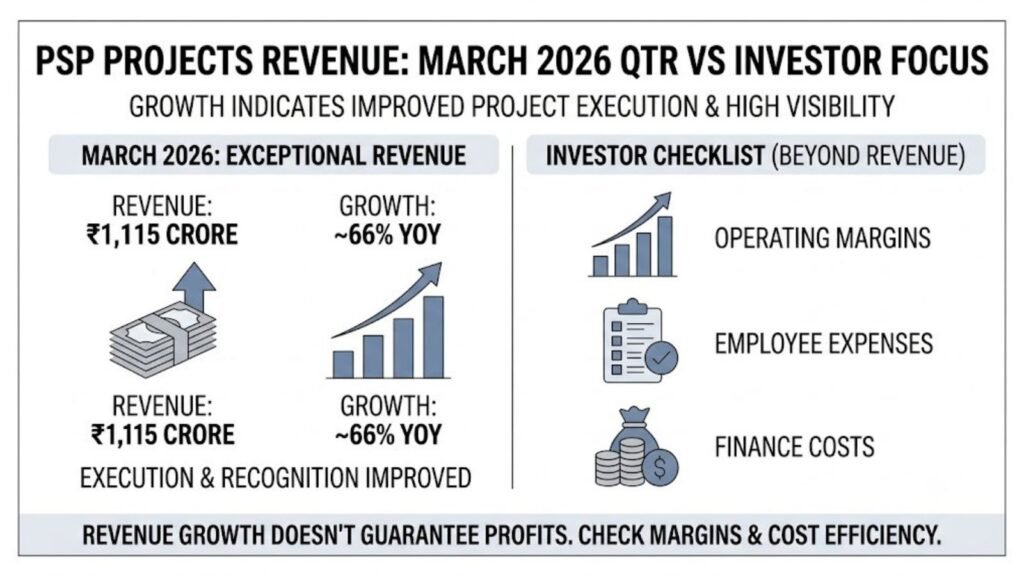
For a construction company, revenue growth usually depends on several factors. These factors include the number of active projects, the speed of project execution, availability of labour and materials, timely payments from clients, progress in large contracts, and new order inflows. The latest revenue growth suggests that project execution improved during the quarter. But higher revenue does not automatically mean higher profits. Investors must focus on operating margins, employee expenses, finance costs and provisions.
PSP Projects Has a Strong Order Book of Around ₹13,447 Crore
PSP Projects’ large order book is another major reason investors are interested in the company. The company’s order book reportedly stood at approximately ₹13,447 crore in mid-2026. An order book represents the total value of projects that a company has received but has not yet fully completed. A large order book provides future revenue visibility because the company already has confirmed work that may be executed over the next several years.
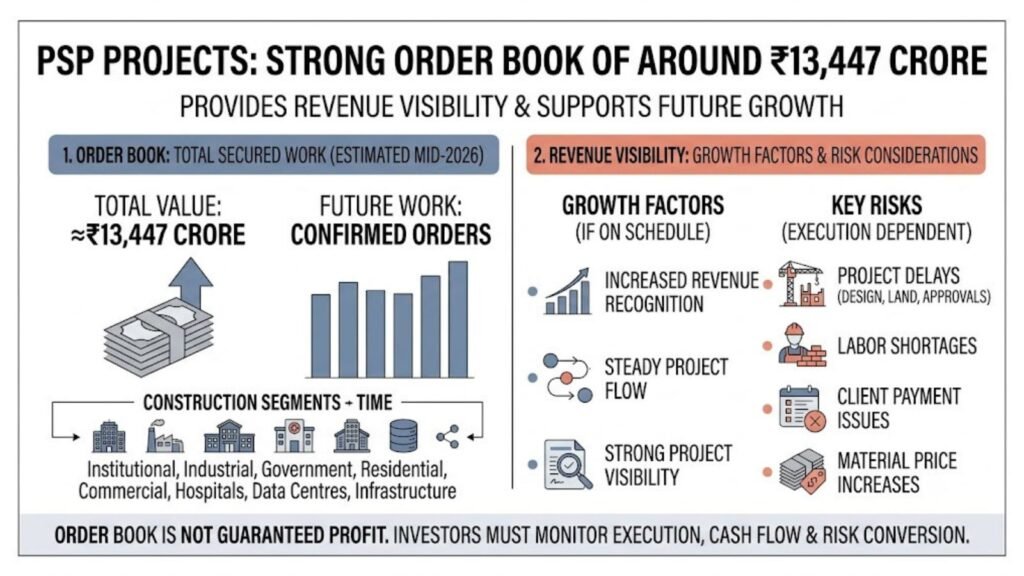
PSP Projects operates in different construction segments, including institutional buildings, industrial projects, government buildings, residential developments, commercial properties, hospitals, hotels, data centres, and sports and public infrastructure. The strong order book indicates that the company may continue reporting revenue growth if it completes projects on schedule. However, the value of an order book should not be treated as guaranteed profit. Construction projects can face delays because of land issues, labour shortages, changes in design, government approvals, client payments, or increases in material prices. Therefore, investors should monitor how quickly PSP Projects converts its order book into revenue and cash flow.
FY27 Revenue Guidance Has Improved Investor Confidence
PSP Projects management has reportedly guided for revenue of approximately ₹4,500 crore in FY27. The company also expects medium-term revenue growth of around 20 percent to 25 percent. This guidance has created optimism because it suggests management expects the current order book to support strong business growth.
The company is targeting an EBITDA margin of approximately 7 percent to 8 percent. It also aims to improve its profit-after-tax margin to around 4 percent to 5 percent over the next two to three years. EBITDA measures profit from normal business operations before interest, taxes, depreciation, and amortisation. A higher EBITDA margin means the company is earning more operating profit from every rupee of revenue. The management guidance is positive, but the company must deliver these margins consistently. Investors will closely compare future quarterly results with the management’s revenue and margin targets.
Adani Group Projects Are a Major Growth Driver
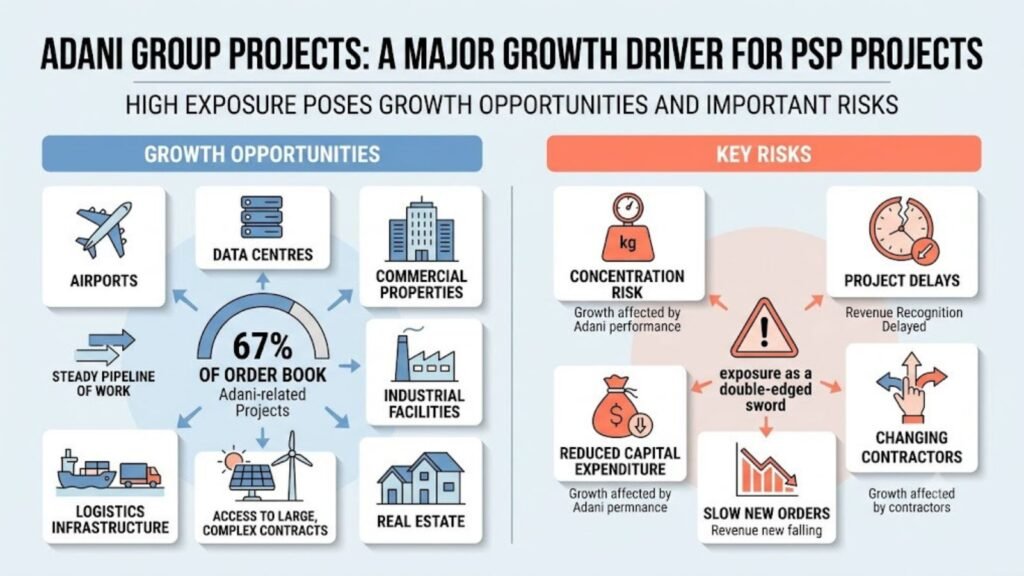
PSP Projects has well exposure to projects connected with the Adani Group. According to some reports, Adani Group-related projects contribute around 67 percent of the company’s order book. This relationship can be a major advantage because the Adani Group continues to invest in areas such as airports, data centres, commercial properties, industrial facilities, logistics infrastructure, energy projects, and real estate developments.
If the Adani Group continues awarding large construction contracts, PSP Projects could benefit from a steady pipeline of work. The relationship may also help PSP Projects participate in larger and more complex projects. This is one reason some investors have a positive long-term view of the company. However, a high dependence on one business group also creates concentration risk. If the Adani Group delays projects, reduces capital expenditure, changes contractors, or slows new orders, PSP Projects’ growth could be affected. Because of this, Adani exposure is both a growth opportunity and an important risk.
Data-Centre Construction Could Become a New Growth Opportunity
The growth of data centres in India is creating new opportunities for engineering and construction companies. Demand for data centres is rising because of growth in cloud computing, artificial intelligence, digital payments, online services, video streaming, e-commerce, government digital platforms, and corporate data storage. Data centres require specialised buildings, reliable electricity, cooling systems, security infrastructure, and high-quality construction.
PSP Projects has been mentioned as a possible beneficiary of upcoming data-centre construction opportunities. If the company wins and executes more data-centre contracts, it could diversify its order book and reduce its dependence on traditional building projects. However, investors should focus on confirmed orders rather than only possible opportunities. Future growth from data centres will depend on actual contract wins, project size, execution timelines, and profit margins.
PSP Projects Five-Year Revenue Performance
The company’s revenue has grown significantly over the past five years, although growth has not been consistent every year. The following table presents the annual revenue and year-on-year growth for PSP Projects.
| Financial Year | Revenue from Operations | Year-on-Year Growth |
|---|---|---|
| FY21 | ₹1,240.86 crore | -17.27 percent |
| FY22 | ₹1,748.76 crore | 40.90 percent |
| FY23 | ₹1,938.00 crore | 10.81 percent |
| FY24 | ₹2,462.50 crore | 27.81 percent |
| FY25 TTM | ₹2,407.00 crore | -2.25 percent |
Revenue declined during FY21, when construction activities were affected by pandemic-related disruptions. The company then reported strong growth of more than 40 percent in FY22. Revenue continued to grow in FY23 and FY24. It reached approximately ₹2,462.50 crore in FY24, compared with ₹1,240.86 crore in FY21. This means the company nearly doubled its annual revenue over three years. However, the available FY25 trailing data showed a small revenue decline of approximately 2.25 percent. The recent March 2026 quarter showed a stronger recovery, with reported revenue growth of around 66 percent. This improvement is one of the major reasons investors are again focusing on PSP Projects shares.
Profit Growth Has Not Matched Revenue Growth
Although PSP Projects has increased its revenue, its profit performance has remained weak. The following table presents the annual profit after tax and year-on-year growth for PSP Projects.
| Financial Year | Profit After Tax | Year-on-Year Growth |
|---|---|---|
| FY21 | ₹80.79 crore | -36.89 percent |
| FY22 | ₹162.40 crore | 101.05 percent |
| FY23 | ₹133.02 crore | -18.08 percent |
| FY24 | ₹123.90 crore | -6.86 percent |
| FY25 TTM | ₹22.00 crore | -82.24 percent |
The company reported a strong profit recovery in FY22, when profit after tax increased to ₹162.40 crore. However, profit declined during the following years. Profit fell to ₹133.02 crore in FY23 and ₹123.90 crore in FY24. The available FY25 trailing data showed a much sharper decline, with profit falling to approximately ₹22 crore. This difference between revenue growth and profit growth is an important concern. PSP Projects is receiving and executing more work, but the company is not retaining the same level of profit from that revenue. The company must improve its operating margins for the share price to maintain a strong long-term upward trend.
PSP Projects Net Profit Margin Has Declined
The company’s net profit margin shows how much final profit it earns from every ₹100 of revenue. The following table presents the revenue, profit after tax, and net profit margin for PSP Projects over the past five years.
| Financial Year | Revenue | Profit After Tax | Net Profit Margin |
|---|---|---|---|
| FY21 | ₹1,240.86 crore | ₹80.79 crore | 6.51 percent |
| FY22 | ₹1,748.76 crore | ₹162.40 crore | 9.29 percent |
| FY23 | ₹1,938.00 crore | ₹133.02 crore | 6.86 percent |
| FY24 | ₹2,462.50 crore | ₹123.90 crore | 5.03 percent |
| FY25 TTM | ₹2,407.00 crore | ₹22.00 crore | 0.91 percent |
The net profit margin increased to 9.29 percent in FY22. It then declined to 6.86 percent in FY23 and 5.03 percent in FY24. The available FY25 trailing margin fell sharply to approximately 0.91 percent. A margin of 0.91 percent means the company earned less than ₹1 in final profit from every ₹100 of revenue. This is why margin recovery is more important than revenue growth alone. If PSP Projects achieves its target PAT margin of 4 percent to 5 percent, its profit could improve significantly even without a major change in revenue growth. However, failure to improve margins could limit future share-price gains.
Why Are PSP Projects Margins Under Pressure
Several factors have affected the company’s operating and profit margins. These factors include higher labour expenses, fixed-price contracts, early stages of new projects, delays and provisions, and commodity-price changes. Construction companies require a large workforce. Changes connected with labour regulations and employee benefits reportedly increased PSP Projects’ employee costs by approximately one percentage point. Even a small increase in labour expenses can affect profitability when projects operate on thin margins.
Some construction contracts are awarded at fixed prices. If cement, steel, fuel, wages, or other costs increase after the contract is signed, the company may not always be able to pass the full increase to the client. This reduces the profit earned from the project. New projects may initially produce lower margins because companies must spend money on mobilisation, equipment, employees, temporary facilities, and project preparation. Margins may improve after the project reaches a more advanced stage. PSP Projects reportedly created a provision of approximately ₹29 crore related to delays and expected credit losses connected with the Kashi project. A provision reduces reported profit because the company recognises the possibility that it may not recover the entire amount. Changes in the prices of steel, cement, aluminium, fuel, and other materials can also affect construction costs.
Receivables of ₹928 Crore Create a Working-Capital Concern
PSP Projects’ receivables reportedly increased to approximately ₹928 crore by March 2026. Receivables represent money that clients owe the company for work already completed or billed. An increase in receivables is not always negative. It may happen when revenue grows and the company completes more projects. However, receivables become a concern when clients take too long to make payments.
The company still needs to pay employees, suppliers, contractors, lenders, and equipment providers even when customer payments are delayed. This can increase the need for short-term borrowing and raise interest expenses. Investors should monitor several factors related to receivables including how quickly PSP Projects collects payments, the age of outstanding receivables, cash flow from operations, short-term borrowings, provisions for doubtful debts, and payments from major clients. Strong accounting profit does not always produce strong cash flow. For construction companies, cash collection is especially important.
Earnings Per Share Has Declined
PSP Projects’ earnings per share have weakened after reaching a high level in FY22. The following table presents the earnings per share for PSP Projects over the past five years.
| Financial Year | Earnings Per Share |
|---|---|
| FY21 | ₹22.65 |
| FY22 | ₹46.29 |
| FY23 | ₹36.65 |
| FY24 | ₹34.16 |
| FY25 TTM | ₹5.59 |
EPS increased sharply to ₹46.29 in FY22. It then declined to ₹36.65 in FY23 and ₹34.16 in FY24. The available FY25 trailing EPS fell significantly to ₹5.59. EPS measures the profit attributable to each outstanding share. When EPS declines while the share price rises, the stock becomes more expensive in relation to its earnings. Therefore, the company needs to restore earnings growth to support a sustainable long-term share-price increase.
Return on Equity Has Also Weakened
Return on equity measures how efficiently a company uses shareholders’ money to generate profit. PSP Projects’ five-year average return on equity was approximately 15 percent. The three-year average declined to around 12 percent, while FY24 ROE stood near 5 percent. The decline shows that the company is generating less profit from its equity base than it did previously. Improving profit margins, project execution, and cash collection could help the company improve ROE in future years.
PSP Projects Debt Position Has Improved
The company’s debt-to-equity ratio increased sharply in FY24 but improved during the following period. The debt-to-equity ratio increased from 0.18 in FY23 to 0.50 in FY24. It later improved to around 0.23 as debt declined and net worth increased. A ratio of 0.23 means the company has approximately ₹0.23 of debt for every ₹1 of shareholder equity. The improvement is positive because lower debt can reduce interest expenses and financial risk. However, investors should continue monitoring borrowings because construction companies often require significant working capital.
Promoter Holding Remains an Important Factor
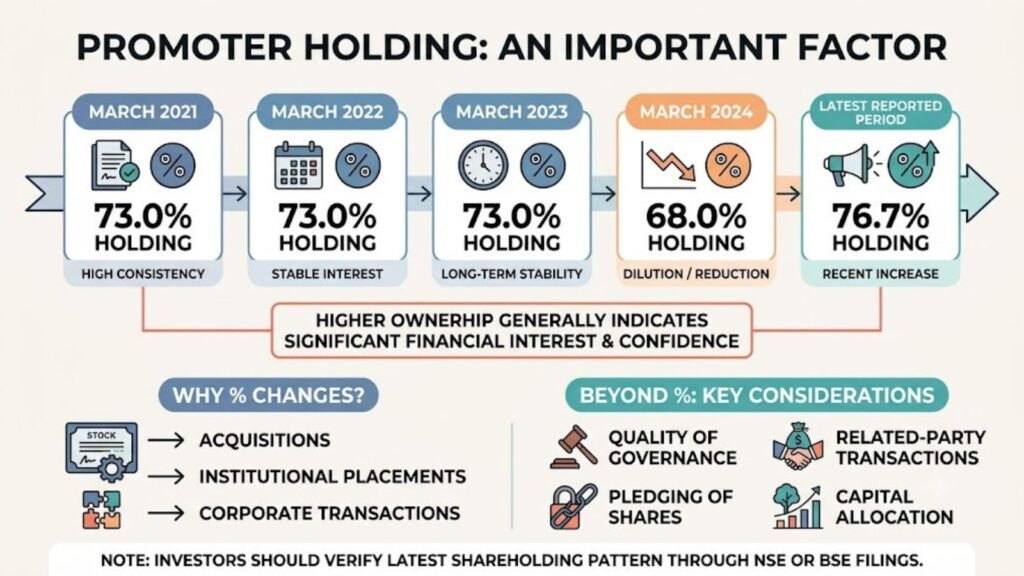
Promoter holding has remained relatively high over the past several years. Promoter holding was approximately 73.0 percent in March 2021, remained around 73.0 percent in March 2022 and March 2023, declined to approximately 68.0 percent in March 2024, and increased to approximately 76.7 percent in the latest reported period. Higher promoter ownership generally indicates that the promoters continue to have significant financial interest in the company. However, investors should verify the latest shareholding pattern through NSE or BSE filings. Changes in share capital, acquisitions, institutional placements, or corporate transactions can affect the promoter-holding percentage. The quality of governance, related-party transactions, pledging of shares, and capital allocation are also more important than the ownership percentage alone.
PSP Projects Is Not Currently a Dividend-Focused Stock
PSP Projects’ dividend payout has reduced over the past several years. Dividend payout as a percentage of profit was 18 percent in FY21, 11 percent in FY22, 7 percent in FY23, and 0 percent in FY24 and the latest trailing period. The company did not report a dividend for FY24 in the supplied data, and its latest indicated dividend yield was 0 percent. Because of this, PSP Projects may be more suitable for investors seeking business growth rather than regular dividend income. Future dividends will depend on profitability, cash flow, working-capital requirements, debt, and the company’s investment plans.
Is PSP Projects a Good Stock to Buy
PSP Projects has several positive qualities. The company has a large order book, strong recent revenue growth, exposure to major infrastructure projects, and ambitious FY27 guidance. Possible opportunities in data centres and continued work from large clients may support future growth. The company’s improved debt-to-equity ratio is another positive factor. However, PSP Projects also faces important risks. Its profit margins have declined, earnings per share have weakened, receivables have increased, and a large portion of the order book may depend on Adani Group companies. The overall analyst view appears mixed, with a Hold bias and some negative recommendations.
Therefore, the stock may appeal to investors who believe that PSP Projects can achieve the following: execute its order book on time, restore operating margins, improve cash collection, reduce dependence on individual clients, generate stronger profit growth, and win more data-centre and infrastructure projects. Investors should not make a decision based only on revenue growth or the size of the order book. Profit margins, operating cash flow, client concentration, debt, and project execution are equally important.
What Is the Future Price of PSP Projects Share
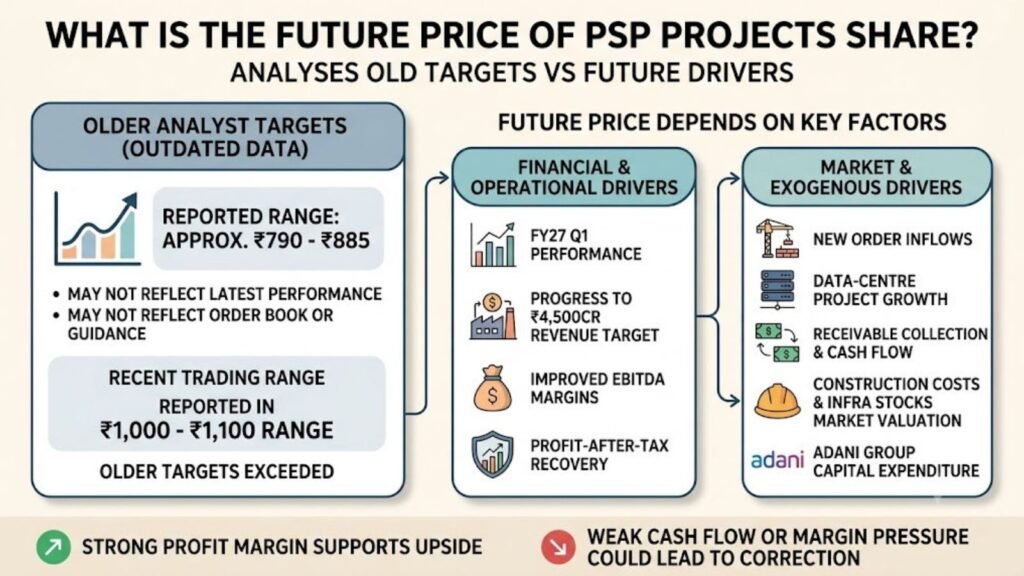
The supplied data does not provide one reliable and current analyst target that can be treated as a clear future price. Some older analyst targets were reportedly between approximately ₹790 and ₹885. However, these targets may no longer reflect the company’s latest financial performance, share price, order book, or management guidance. Recent trading was reported in the ₹1,000 to ₹1,100 range, meaning older targets may already have been reached or exceeded.
The future price of PSP Projects shares will mainly depend on several factors including Q1 FY27 financial performance, progress toward the ₹4,500 crore revenue target, improvement in EBITDA margins, recovery in profit-after-tax margins, new order inflows, growth in data-centre projects, receivable collection, cash flow from operations, Adani Group capital expenditure, changes in construction costs, and market valuation of infrastructure stocks. A stronger profit margin could support further upside. However, continued margin pressure or weak cash flow could lead to a share-price correction even if revenue continues to grow. Analyst targets are estimates and should not be treated as guaranteed future prices.
PSP Projects Q1 FY27 Results Could Be the Next Major Catalyst
PSP Projects is expected to discuss or announce its Q1 FY27 financial results on July 30, 2026. The results could become an important short-term catalyst for the share price. Investors are likely to focus on several metrics when the results are announced including quarterly revenue growth, EBITDA margin, net profit, new order wins, total order-book value, cash flow, receivables, management’s FY27 guidance, data-centre opportunities, and Adani Group project execution. If the results show strong revenue growth together with improving margins, investor confidence may increase. However, if revenue grows but profits and cash flow remain weak, the market may question whether the company can achieve its medium-term targets.
Risks That Could Stop the Share-Price Rise
PSP Projects faces several risks that could stop the share-price rise or cause a correction. Weak profit margins remain a concern because revenue growth has not produced equally strong profit growth. If margins remain low, the company may struggle to justify a higher valuation. High client concentration exists because a large percentage of the company’s order book reportedly comes from Adani Group projects. Any slowdown in orders from the group could affect PSP Projects’ growth. Rising receivables of around ₹928 crore could increase the company’s working-capital requirements. Delayed client payments may weaken cash flow and increase borrowing.
Project-execution delays can occur due to labour shortages, regulatory delays, land issues, design changes, and material shortages. These problems can delay revenue and reduce margins. Fixed-price contracts can reduce profitability when unexpected increases in steel, cement, wages, or fuel occur and contracts do not allow full cost recovery. Valuation risk exists if the share price rises faster than profit and EPS, making the stock expensive. A weak quarterly result could then cause a sharp correction. Economic and infrastructure slowdown could reduce new order inflows.
What Should Investors Watch Next
Investors should closely monitor PSP Projects’ Q1 FY27 results and progress toward the management’s annual guidance. The most important factors to track include FY27 revenue growth, EBITDA margin movement, profit-after-tax margin, new order inflows, total order-book value, share of Adani Group projects, data-centre order wins, trade receivables, operating cash flow, debt and interest costs, provisions for delayed projects, promoter holding, and project completion timelines. The quality of growth is more important than revenue growth alone. A healthy business should convert revenue into profit and profit into operating cash flow.
Conclusion
PSP Projects share is attracting attention because of strong revenue growth, a large order book of approximately ₹13,447 crore, positive management guidance, and exposure to major infrastructure and data-centre projects. The company has reported strong revenue growth of around 66 percent in the March 2026 quarter and has guided for revenue of approximately ₹4,500 crore in FY27 with medium-term growth of 20 percent to 25 percent. However, the company’s profit performance has not matched its revenue growth. Net profit margins have declined from 9.29 percent in FY22 to approximately 0.91 percent in the FY25 trailing period. Earnings per share have fallen sharply, receivables have increased to around ₹928 crore, and a large portion of the order book depends on Adani Group projects. The company must now execute its order book successfully, restore profit margins, improve cash collection, and reduce client concentration to justify a sustained share-price rise. PSP Projects’ Q1 FY27 results, expected on July 30, 2026, will be an important test of whether the company can convert its order book into stronger profits and cash flow.
Frequently Asked Questions
Q1. Why is PSP Projects share rising?
A1. PSP Projects share is rising due to strong revenue growth of around 66% in the March 2026 quarter, a large order book of ₹13,447 crore, positive management guidance of ₹4,500 crore revenue in FY27, and exposure to Adani Group projects and data centre opportunities.
Q2. What is PSP Projects’ order book size?
A2. PSP Projects’ order book reportedly stood at approximately ₹13,447 crore in mid-2026, providing strong revenue visibility for the upcoming years.
Q3. What is the management’s revenue guidance for FY27?
A3. PSP Projects management has guided for revenue of approximately ₹4,500 crore in FY27 and expects medium-term revenue growth of around 20 percent to 25 percent.
Q4. What are the key risks for PSP Projects investors?
A4. Key risks include weak profit margins, high client concentration on Adani Group projects (around 67% of order book), rising receivables of ₹928 crore, project execution delays, and valuation risk.
Q5. When is PSP Projects expected to announce Q1 FY27 results?
A5. PSP Projects is expected to discuss or announce its Q1 FY27 financial results on July 30, 2026. These results could become an important short-term catalyst for the share price.