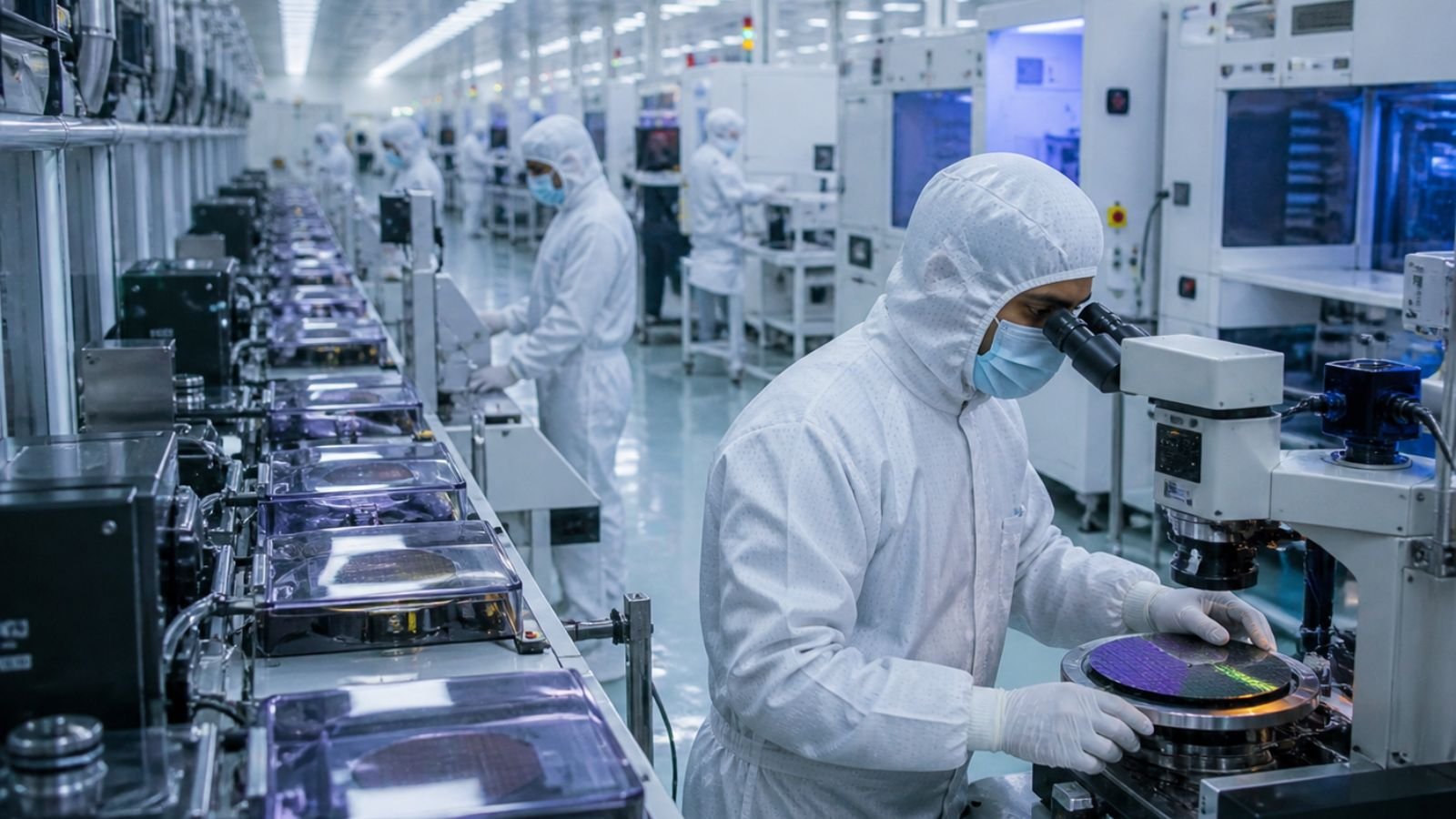
On May 5, 2026, the Union Cabinet chaired by Prime Minister Narendra Modi approved two major semiconductor projects under the India Semiconductor Mission. With these approvals, the total number of sanctioned projects has reached 12, and cumulative investments have surged to approximately ₹1.64 lakh crore, marking a significant milestone in India’s push to become a global semiconductor hub.
Approved Projects & Locations
Crystal Matrix Limited (CML)
- Location: Dholera
- Investment: ₹3,068 crore
- Key Highlight: India’s first commercial Mini/Micro-LED display facility
- Technology: Based on Gallium Nitride (GaN)
This project positions India at the forefront of next-generation display technologies used in smartphones, automotive systems, and wearables.
Suchi Semicon Private Limited (SSPL)
- Location: Surat
- Investment: ₹868 crore
- Facility Type: OSAT (Outsourced Semiconductor Assembly and Test)
This unit will strengthen India’s backend semiconductor ecosystem, focusing on packaging and testing critical electronic components.
Production Capabilities
Next-Generation Displays
Crystal Matrix is expected to manufacture 72,000 square metres of Mini/Micro-LED panels annually, catering to industries like smartphones, smartwatches, and automotive displays.
High-Volume Chip Manufacturing
Suchi Semicon aims to produce over 1.033 billion discrete semiconductor chips per year, supporting power electronics, industrial automation, and consumer electronics (including ACs and EVs).
Economic & Strategic Impact
Employment Generation
These projects are projected to create around 2,230 high-skilled jobs, boosting India’s tech workforce.
Strengthening Global Position
The approvals follow major developments like investments by Micron Technology and Kaynes Semicon, reinforcing Gujarat’s role as India’s semiconductor hub.
Financial Incentives & Government Support
The Government of India and Gujarat offer strong incentives to attract semiconductor investments:
Central Government Support
- Provides 50% of project cost under ISM
- Funds released progressively as projects advance
Gujarat State Incentives
- Additional 40% subsidy on central incentive
- Total support reaches nearly 70% of project cost
Operational Benefits
- Electricity subsidy: ₹2 per unit for 10 years
- Water supply at subsidized industrial rates
- Land subsidy: Up to 75% for first 200 acres in Dholera Semicon City
- Tax benefits: 100% reimbursement of stamp duty and registration charges

The Shift to ISM 2.0
The Cabinet also signaled a transition toward ISM 2.0, focusing on deeper technological independence:
Indigenous Manufacturing Push
India aims to produce semiconductor fabrication equipment, specialized gases and materials, and develop full-stack chip ecosystem.
Full-Stack Chip Ecosystem
Focus on developing indigenous chip designs (IP ownership), reducing reliance on foreign technologies.
Advanced Technology Nodes
Future investments will target 3nm and 2nm chip technologies, aligning India with global leaders.
Industry Impact & Future Outlook
By 2030, India’s semiconductor market is projected to reach 100to110 billion. Supporting this growth:
- The Chips to Startup (C2S) program is training 85,000 professionals
- Over 113 academic institutions are involved in advanced chip design education
These developments indicate a strong roadmap toward making India a self-reliant semiconductor powerhouse.
Conclusion
The approval of new semiconductor projects in Gujarat marks a crucial step in India’s technological and economic transformation. With strong government backing, strategic investments, and a focus on innovation, India is rapidly positioning itself as a key player in the global semiconductor ecosystem.
Frequently Asked Questions
Q1. How many semiconductor projects have been sanctioned under ISM 2026?
A1. With the latest approvals, the total number of sanctioned semiconductor projects has reached 12.
Q2. What is the total investment amount of semiconductor projects in India under ISM 2026?
A2. Cumulative investments have surged to approximately ₹1.64 lakh crore.
Q3. Where are the two newly approved semiconductor projects located?
A3. Crystal Matrix Limited is located in Dholera, and Suchi Semicon Private Limited is located in Surat.
Q4. What is the production capacity of Suchi Semicon’s OSAT facility?
A4. Suchi Semicon aims to produce over 1.033 billion discrete semiconductor chips per year.
Q5. What is the total government support percentage for semiconductor projects in Gujarat?
A5. Central government provides 50% support under ISM, and Gujarat state provides an additional 40% subsidy, totaling nearly 70% of project cost.