
The National Testing Agency (NTA) has officially announced the RE-NEET UG 2026 re-examination for June 21, 2026, after the cancellation of the earlier May examination cycle. With approximately 30 days remaining before the revised examination, the preparation strategy now shifts away from basic syllabus completion and moves toward high-speed revision, active recall, smart question selection, and performance-based error analysis. According to the provided preparation blueprint, students are strongly advised not to restart preparation from zero. Instead, aspirants should focus on rapid NCERT revision, high-weightage chapters, PYQ practice, mock test conditioning, OMR accuracy, and mistake tracking systems.
RE-NEET UG 2026: Why the Final 30 Days Matter Most
Foundational study should already be completed. The final month should focus on revision efficiency and exam execution. Chaotic preparation leads to burnout, while structured milestones improve consistency and control. Instead of reading entire textbooks repeatedly, the strategy prioritizes active recall, mock-test repetition, formula reinforcement, high-yield MCQ solving, and error analysis systems. This final month is presented as a performance optimization phase, not a syllabus-building phase.
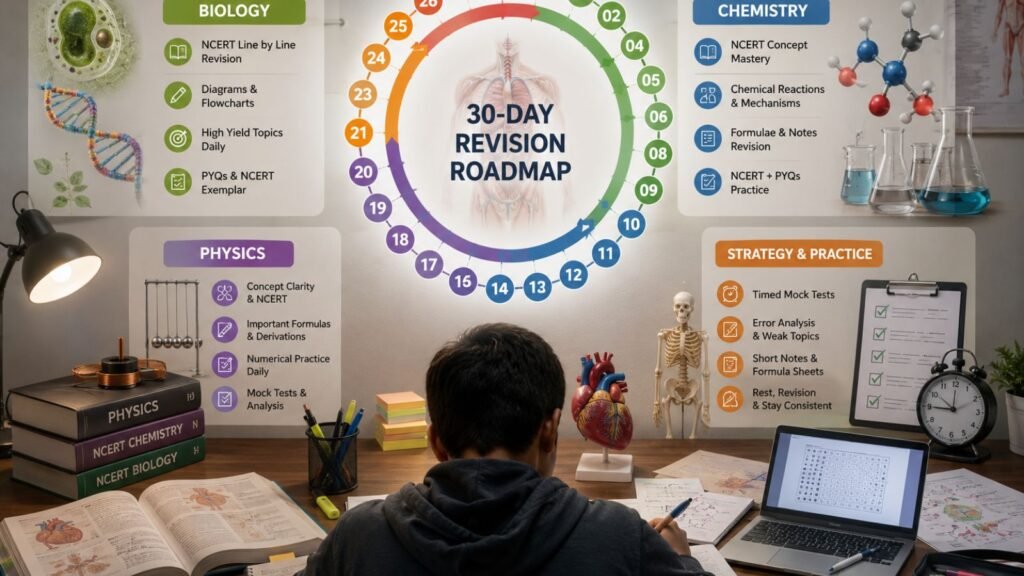
The 30-Day RE-NEET UG 2026 Roadmap
Days 1 to 10: High-Weightage Lockdown Phase
The first 10 days are focused entirely on high-yield chapters, frequently tested concepts, and core scoring areas. Students should target chapters contributing nearly 80% of the exam’s effective weightage.
- Biology Focus Areas: Human Physiology, Genetics, Ecology. These chapters are high-return scoring units, NCERT-heavy, and conceptually repetitive across years. Deep NCERT reading, diagram recall, and table memorization are emphasized.
- Physics Focus Areas: Modern Physics, Current Electricity. Formula application is direct, question repetition trends remain strong, and numerical solving speed can be improved quickly.
- Chemistry Focus Areas: Organic Chemistry basics, Coordination Compounds. Mechanism understanding, reagent memorization, and structural pattern recognition are stressed.
Days 11 to 21: Reverse Engineering & Application Phase
The second preparation phase shifts from reading-based learning to problem-solving execution. Students should begin testing retention limits.
PYQ-Based Preparation
Solving the last 15 years’ Previous Year Questions (PYQs) under strict time pressure is strongly recommended. This phase focuses on pattern recognition, question filtering, speed improvement, and weakness detection.
Problem-Solving Over Passive Reading
Replace passive theory reading with active application including timed MCQs, numerical solving, rapid recall drills, and mistake correction cycles. Application memory is stronger than passive revision memory during the final month.
Days 22 to 30: Full-Length Exam Conditioning
The final preparation phase is designed to simulate real exam conditions. Students should transition into complete mock-test mode.
Mock Test Timing Synchronization
Sit for full-length tests from 2:00 PM to 5:20 PM for biological clock synchronization. This helps students adapt mentally, improve concentration during actual exam hours, and reduce fatigue on exam day.
OMR Sheet Training
Physical OMR practice is strongly emphasized. OMR shifting mistakes can become costly in competitive exams. Students should practice darkening circles accurately, avoid question-number mismatches, and develop bubbling rhythm.
Final Three-Day Revision Strategy
The last three days before RE-NEET UG 2026 should focus only on formula books, NCERT diagrams, and rapid revision notes. Avoid starting new chapters, learning unfamiliar concepts, or excessive mock testing.
Subject-Wise RE-NEET UG 2026 Revision Execution
Biology: Zero-Tolerance NCERT Tracking
Biology remains the highest-scoring section in NEET UG. Students should target 350+ marks through strict NCERT revision.
- Line-by-Line NCERT Scanning: Special emphasis on Class 12 Biology chapters. Direct NCERT statements frequently appear in NEET questions.
- Visual Trigger Revision: Revise tables, flowcharts, summary boxes, and labelled diagrams. Visual memory significantly improves retention under pressure.
- Biology MCQ Volume: Solve 100 to 120 Biology MCQs daily focusing on high-yield topics, NCERT fact recall, and statement-based questions.
Chemistry: Segmented Memorisation & Practice
- Organic Chemistry Strategy: Write mechanisms by hand, memorize named reactions, and practice reagent conditions repeatedly. Active handwritten recall over reading-only revision.
- Inorganic Chemistry Strategy: Revise similarly to Biology using flashcards, short notes, and NCERT fact recall systems. Focus on periodic trends, anomalies, and metallurgy facts.
- Physical Chemistry Strategy: Maintain a dedicated formula notebook. Solve stoichiometry problems, practice equilibrium numericals, and revise formula-based calculations.
Physics: Formula Application & Speed Control
- Dual Formula Drill System: Revise formula sheets twice daily – once after waking up and once before sleeping – to improve memory retention and strengthen instant recall.
- High-Volume Physics MCQ Sessions: Solve 40 to 50 Physics MCQs daily using countdown timers, solving each question within 60 seconds to develop speed control, decision-making, and calculation discipline.
- Core Physics Chapters: Mechanics, Electrostatics, Optics, and Modern Physics are high-frequency scoring areas and numerical-heavy sections.
Core Execution Metrics for RE-NEET UG 2026
The 12-Hour Study Breakdown
- Morning (4 Hours): Biology revision, NCERT scanning, MCQ practice
- Afternoon (4 Hours): Chemistry reactions, Physical Chemistry numericals, formula practice
- Evening (3 Hours): Physics problem-solving, speed-based MCQ sessions
- Night (1 Hour): Mistake analysis, error correction notebook updates
The “Mistake Log” System
Maintain a dedicated mistake notebook to record tricky concepts, track repeated errors, and note careless calculation slips. Review this notebook every Sunday to reduce repetition of mistakes and improve question selection accuracy.
Two-Round Solving Strategy
- Round 1: Solve direct questions, easy conceptual MCQs, and straightforward biology statements
- Round 2: Attempt lengthy numericals, calculation-heavy physics, and difficult chemistry questions
Skip highly confusing questions entirely. Accuracy preservation is more important than reckless attempts.
Why Active Recall Matters for RE-NEET UG 2026
Active recall includes writing formulas repeatedly, solving MCQs under pressure, revising diagrams from memory, and attempting PYQs without hints. Rapid retrieval training improves retention significantly during competitive exams.
Final RE-NEET UG 2026 Strategy Takeaways
- Controlled revision
- Time management
- Error reduction
- Exam conditioning
Do not panic, restart the syllabus, or overload yourself with new material. The final month should revolve around high-yield chapters, mock test repetition, NCERT mastery, and speed-based execution.
Conclusion
The RE-NEET UG 2026 re-exam has created a fresh 30-day preparation window that demands a completely different strategy from traditional long-term study planning. According to the provided roadmap, success in the revised examination depends less on new learning and more on revision efficiency, question filtering, active recall, and mock-test conditioning. The preparation model strongly prioritizes Biology NCERT tracking, Chemistry mechanism memorization, Physics formula application, and structured mistake analysis. Students are advised to follow a disciplined phase-wise roadmap covering high-weightage chapters, PYQ practice, and full-length exam simulation to maximize their final performance before June 21, 2026. The overall strategy is designed to improve accuracy, retention, time management, confidence, and real exam execution.
Frequently Asked Questions
Q1. What is the RE-NEET UG 2026 exam date?
A1. The RE-NEET UG 2026 re-examination is scheduled for June 21, 2026.
Q2. How should students spend the first 10 days of preparation?
A2. The first 10 days should focus on high-weightage chapters including Human Physiology, Genetics, Ecology in Biology; Modern Physics and Current Electricity in Physics; and Organic Chemistry basics in Chemistry.
Q3. What is the recommended mock test timing synchronization?
A3. Students should sit for full-length tests from 2:00 PM to 5:20 PM to synchronize their biological clock with actual exam hours.
Q4. How many Biology MCQs should be solved daily during revision?
A4. Students should solve 100 to 120 Biology MCQs daily focusing on high-yield topics and NCERT fact recall.
Q5. What is the two-round solving strategy for RE-NEET UG 2026?
A5. Round 1 solves direct questions and easy MCQs. Round 2 attempts lengthy numericals and difficult questions. Highly confusing questions should be skipped entirely.