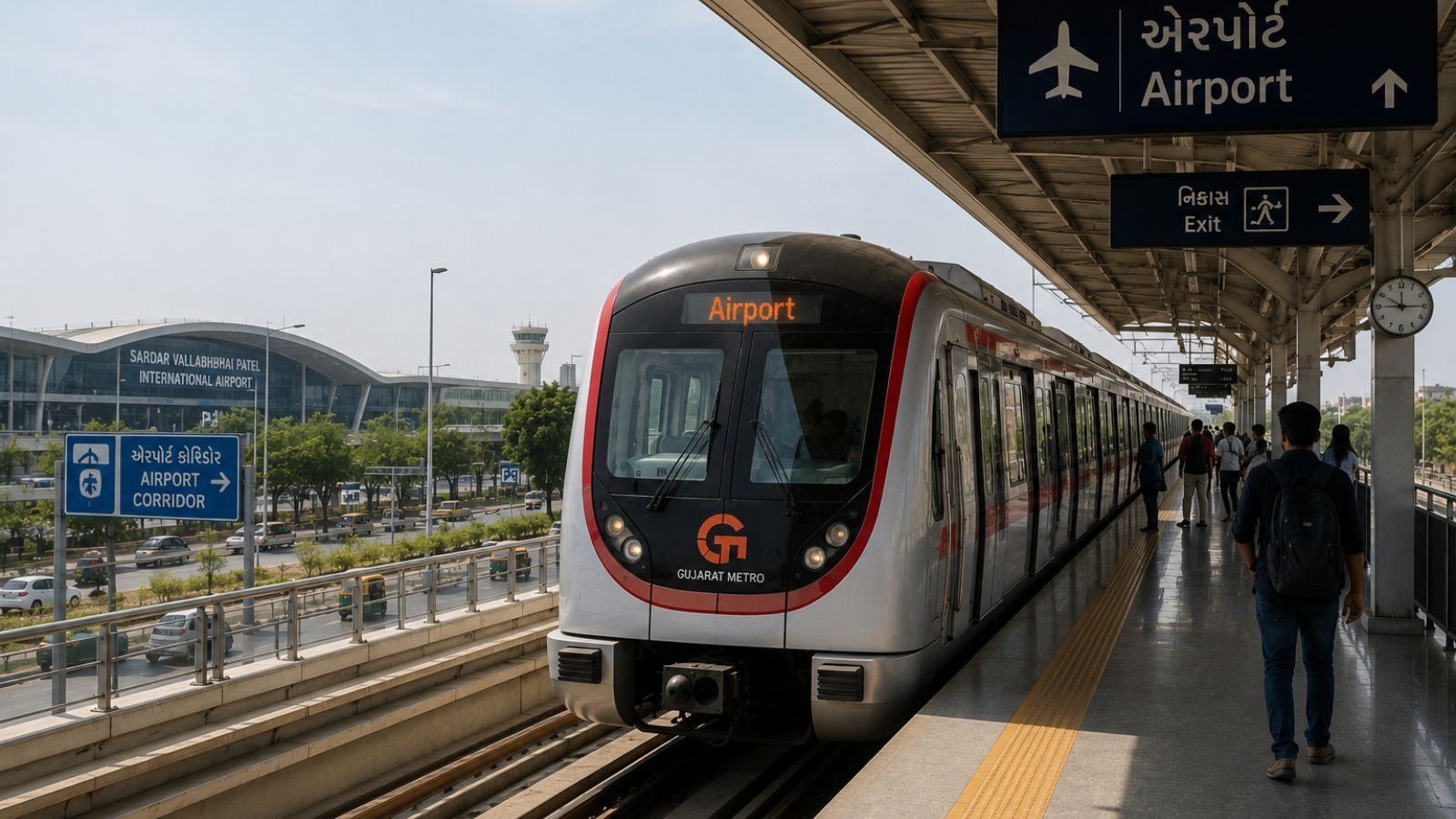
The Union Cabinet, chaired by Prime Minister Narendra Modi, has approved the Ahmedabad Metro Phase 2A project, a major urban transport expansion designed to strengthen connectivity between Ahmedabad, Gandhinagar and the Sardar Vallabhbhai Patel International Airport. Approved on June 10, 2026, the project carries a total investment of ₹2,169.04 crore and will add a dedicated 6.032 kilometre airport corridor to the expanding metro network. The new corridor is expected to play an important role in improving airport access, supporting future urban growth, strengthening public transportation options and enhancing connectivity between major commercial, administrative and residential zones. Once completed, the project will further expand the Ahmedabad Gandhinagar Metro system and create a more integrated transportation network for daily commuters, business travelers and visitors.
Ahmedabad Metro Phase 2A: Project Overview
Ahmedabad Metro Phase 2A is a dedicated airport connectivity corridor that branches from the existing metro network and creates a direct rail connection to the international airport.
| Project Parameter | Detail |
|---|---|
| Corridor Length | 6.032 km |
| Total Project Cost | ₹2,169.04 crore |
| Implementing Agency | Gujarat Metro Rail Corporation (GMRC) |
| Project Approval Date | June 10, 2026 |
| Planned Completion Timeline | Approximately 4 years |
| Network Expansion | Ahmedabad Gandhinagar Metro network to reach 77.63 km |
Why Ahmedabad Metro Phase 2A Is Important
Airport connectivity is considered one of the most important components of modern urban transportation systems. Direct metro access reduces dependency on private vehicles and road based transport while improving travel reliability. The approved Phase 2A corridor is specifically designed to connect Ahmedabad and Gandhinagar with the airport through a dedicated rapid transit route. Instead of depending entirely on road traffic, passengers will have access to a rail based alternative that offers predictable travel schedules. The project also supports Gujarat broader vision of creating an integrated transportation ecosystem linking key business districts, administrative centers and major transport hubs.
Airport Connectivity Project Details
The new airport line will function as a dedicated spur corridor connected to the existing metro infrastructure.
| Feature | Detail |
|---|---|
| Interchange connectivity | Branches from Phase II Yellow Line at Koteshwar Road Station |
| Design type | Combination of elevated and underground sections |
| Elevated stations | 4 stations |
| Underground station | 1 station (Sardar Vallabhbhai Patel International Airport) |
| Alignment | Elevated viaduct from Koteshwar Road to Taj Hotel Circle, then underground tunnel to airport |
Proposed Ahmedabad Metro Phase 2A Stations
The approved corridor will introduce five new stations along the route.
| Station Name | Type | Area Served |
|---|---|---|
| Ashram Road | Elevated | Central Ahmedabad urban corridor |
| Koteshwar Prachin Mandir | Elevated | Koteshwar region |
| Sabarmati River | Elevated | Sabarmati Riverfront area |
| Sardar Nagar | Elevated | Sardar Nagar residential and commercial zone |
| Sardar Vallabhbhai Patel International Airport | Underground | International Airport complex |
How the New Airport Corridor Will Work
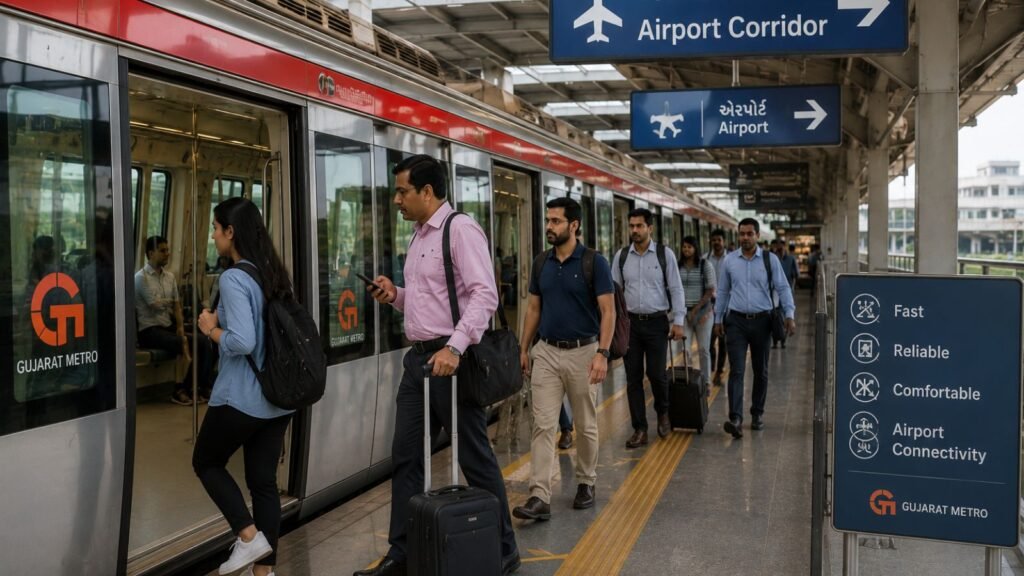
The Phase 2A corridor is designed to operate as a seamless extension of the larger metro network rather than a standalone transport system. Passengers travelling from various parts of Ahmedabad and Gandhinagar will be able to access the airport line through interchange stations and continue their journey without shifting to road transport. This integrated structure improves travel convenience while reducing the number of transfers required during airport trips.
Benefits for Office Commuters and Business Travelers
One of the biggest advantages of the airport corridor is its impact on daily commuting and professional travel.
| Benefit | Description |
|---|---|
| Improved multimodal integration | Connects with Ahmedabad Railway Station, city bus networks, future Mumbai Ahmedabad Bullet Train terminal |
| Reliable travel scheduling | Fixed schedules, predictable travel times, reduced dependency on traffic conditions |
| Faster travel across key zones | Improved travel between GIFT City, Gandhinagar, Ahmedabad commercial districts, and International Airport |
Connectivity Between Ahmedabad, Gandhinagar and GIFT City
A major strength of Phase 2A is its role in linking multiple economic and administrative centers through a unified transit system.
- Connecting major urban hubs including Ahmedabad commercial districts, Gandhinagar administrative institutions, GIFT City financial ecosystem, and International Airport infrastructure
- Better access for developing areas including Bhat, Koteshwar, Sardar Nagal, and Sabarmati Riverfront region
- Support for future international events including the planned Sardar Patel Sports Enclave and future global sporting events
Economic Benefits of Ahmedabad Metro Phase 2A
Large transportation projects often generate economic activity beyond the transport sector itself.
- Approximately 2,000 peak construction jobs may be generated during the development phase
- Around 500 permanent operational and maintenance positions may be created after completion
- Commercial development opportunities around Ashram Road, Koteshwar, and Sardar Nagar due to increased footfall
- Real estate growth potential near metro stations due to better transportation options
Environmental Advantages of the Airport Corridor
Public transportation investments also contribute to sustainability objectives.
- Reduced road congestion through fewer vehicles on roads, reduced congestion, and improved traffic flow
- Lower carbon emissions by reducing dependency on fossil fuel powered road travel
- Long term sustainable mobility through expansion of environmentally friendly transportation infrastructure
Impact on Ahmedabad Growing Transport Network
Ahmedabad Metro Phase 2A is not simply an airport extension. It represents another important building block in the long term development of a comprehensive metropolitan transit system. The corridor strengthens connections between residential neighborhoods, business districts, government centers, airport infrastructure, and future transport projects. This integrated approach can improve mobility across the region while supporting future economic growth.
What Commuters Can Expect in the Coming Years
With a projected completion timeline of approximately four years, construction activities are expected to move through planning, engineering and implementation stages before the corridor becomes operational.
Once completed, passengers will benefit from:
- Direct airport metro access
- Faster multimodal travel
- Better connectivity between Ahmedabad and Gandhinagar
- Improved integration with other transportation systems
- More reliable commuting options
Conclusion
The approval of Ahmedabad Metro Phase 2A marks a significant milestone in Gujarat public transport development. The ₹2,169.04 crore project will add a dedicated 6.032 km airport corridor featuring four elevated stations and one underground airport station, strengthening connectivity between Ahmedabad, Gandhinagar, GIFT City and the Sardar Vallabhbhai Patel International Airport. Beyond transportation improvements, the project is expected to support employment generation, encourage commercial growth, improve travel reliability and contribute to cleaner urban mobility. As Ahmedabad continues expanding its metro infrastructure, Phase 2A represents another step toward building a more connected, efficient and future ready metropolitan transport network.
Frequently Asked Questions
Q1. What is the length and cost of Ahmedabad Metro Phase 2A
A1. The Phase 2A corridor is 6.032 km long with a total project cost of ₹2,169.04 crore, approved on June 10, 2026.
Q2. How many new stations will be added under Phase 2A
A2. Five new stations will be added, including four elevated stations (Ashram Road, Koteshwar Prachin Mandir, Sabarmati River, Sardar Nagar) and one underground airport station.
Q3. What is the planned completion timeline for Ahmedabad Metro Phase 2A
A3. The project is expected to be completed in approximately 4 years.
Q4. How will Phase 2A connect to the existing metro network
A4. The corridor will branch from the recently completed Phase II Yellow Line and use Koteshwar Road Station as the primary interchange point.
Q5. What are the key benefits of the airport metro corridor for commuters
A5. Benefits include direct airport metro access, faster multimodal travel, better connectivity between Ahmedabad and Gandhinagar, reliable travel schedules, and reduced dependency on road traffic.