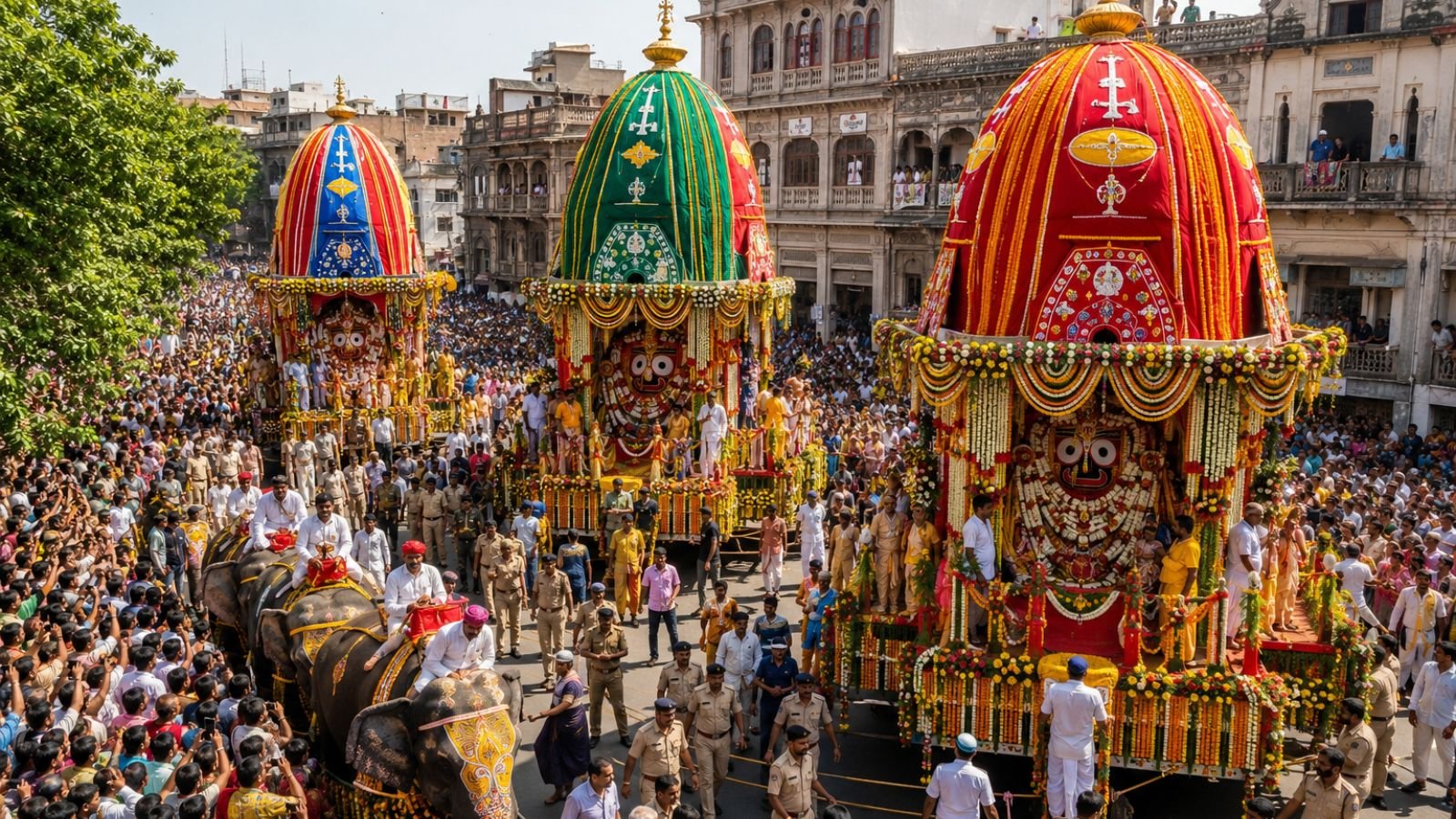
The 149th Jagannath Rath Yatra in Ahmedabad is scheduled to commence on Thursday, 16 July 2026. One of Gujarat’s most significant religious events, the annual Rath Yatra attracts lakhs of devotees from across the state and the country. The historic procession will travel approximately 16 kilometres through the streets of Ahmedabad’s Old City, beginning and ending at the Shree Jagannathji Mandir, Jamalpur. This year, authorities have introduced advanced technology-based security measures, including GPS tracking for elephants, AI-enabled surveillance, drones, and large-scale police deployment to ensure the safety of devotees and the smooth conduct of the event. This guide covers everything devotees need to know, including the complete schedule, procession route, security arrangements, important rituals, and public information.
About the Ahmedabad Jagannath Rath Yatra
The Ahmedabad Jagannath Rath Yatra is one of the oldest and most respected religious processions in Gujarat. The procession begins from the historic Shree Jagannathji Mandir in Jamalpur and follows a traditional 16-kilometre route through the heritage areas of Ahmedabad before returning to the temple. The complete journey generally takes around 13.5 hours, making it one of the largest one-day religious processions in the state. Thousands of devotees line the streets every year to seek blessings from Lord Jagannath, Lord Balabhadra, and Devi Subhadra as the beautifully decorated chariots pass through the city.
High-Tech Security Arrangements for Rath Yatra 2026
Authorities have implemented one of the most advanced security plans in the history of the Ahmedabad Jagannath Rath Yatra.
Gaj Rakshak App for Elephant Monitoring
All 18 elephants participating in the procession have been equipped with modern monitoring technology through the Gaj Rakshak App. The monitoring system includes GPS tracking devices, movement detection sensors, and decibel monitoring sensors. These technologies are intended to monitor the health, movement, and stress levels of the elephants throughout the procession.
Massive Police Deployment
A large security force has been deployed across the entire procession route. More than 31,000 security personnel will monitor the event, including 10 Deputy Inspectors General (DIGs), 42 Deputy Commissioners of Police (DCPs), local police units, and paramilitary forces. The extensive deployment aims to ensure crowd management, maintain law and order, and provide quick emergency response if required.
AI-Based Drone Surveillance
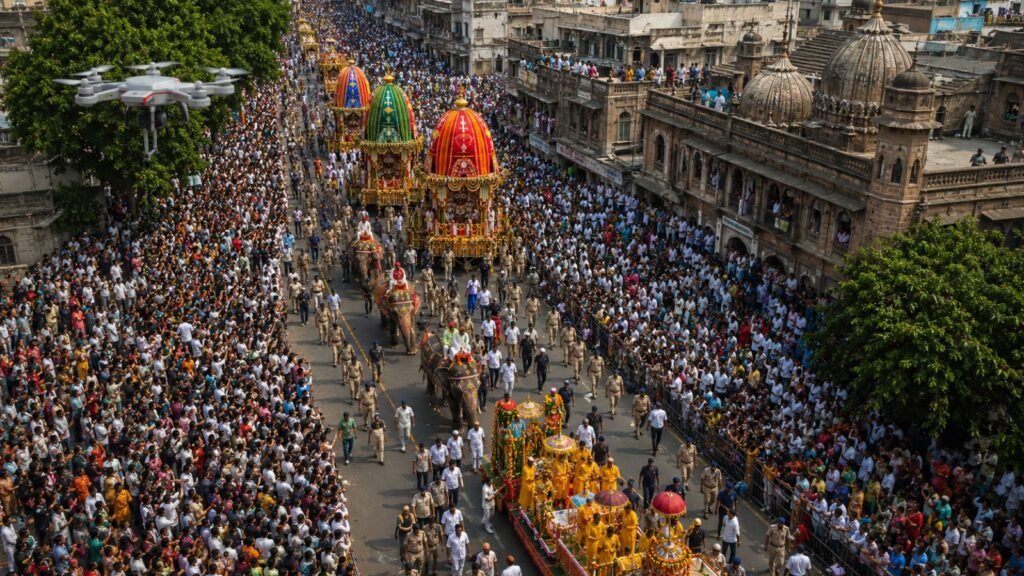
Advanced drone surveillance will operate throughout the 16-kilometre procession route. The drones will assist authorities by monitoring crowd movement, identifying suspicious activities, preventing overcrowding, and supporting emergency response teams. The use of AI-assisted surveillance is expected to improve public safety during the procession.
Decibel Monitoring System
Special sound monitoring devices have also been installed. These decibel meters will continuously monitor loud music and DJ sound levels near the elephants to reduce stress and avoid incidents similar to those reported during last year’s procession.
Complete Rath Yatra Schedule (16 July 2026)
Devotees planning to participate should be aware of the official schedule for the day.
| Time | Event | Description |
|---|---|---|
| 4:00 AM | Mangala Aarti | Traditional morning prayers marking the start of religious ceremonies |
| 6:30 AM | Pahind Vidhi | Gujarat Chief Minister Bhupendra Patel performs ceremonial cleaning of the path |
| 7:00 AM | Rath Yatra Begins | Chariots leave Shree Jagannathji Mandir, Jamalpur |
| 8:30 PM | Return to Temple | Chariots return to the main temple concluding the celebration |
The Pahind Vidhi is a ceremonial ritual involving the symbolic cleaning of the path before the chariots begin their journey. This ritual holds great religious and cultural significance and officially marks the beginning of the procession. The beautifully decorated chariots carrying Lord Jagannath, Lord Balabhadra, and Devi Subhadra will leave the 400-year-old Shree Jagannathji Mandir in Jamalpur and begin the city procession at 7:00 AM.
Major Procession Highlights
Several traditional attractions make the Ahmedabad Rath Yatra one of the most spectacular religious events in Gujarat.
- 18 decorated elephants participating in the grand procession
- 101 cultural theme trucks showcasing various traditions
- 30 Akhadas demonstrating traditional martial arts and religious practices
- 18 Bhajan Mandalis performing devotional songs throughout the route
Thousands of devotees are expected to participate throughout the day.
Mahaprasad Preparation
A large-scale Mahaprasad has been prepared for devotees. The traditional meal includes Malpua, Puri, and Dudhpak. The food arrangements have been made to serve more than 20,000 devotees during the celebration.
Special Care for Lead Elephant ‘Babu’
Authorities have taken additional precautions for Babu, the lead elephant of the procession. Following last year’s incident involving loud whistling and crowd-related stress, the elephant has undergone special crowd exposure training. During the procession, Babu will also receive scheduled snack breaks that include sugarcane and jaggery. These arrangements are intended to ensure the elephant remains calm and comfortable throughout the event.
Complete Rath Yatra Route
The Ahmedabad Jagannath Rath Yatra follows its traditional 16-kilometre heritage route through the Old City before returning to the temple.
Morning Route (Outbound Journey)
| Location | Significance |
|---|---|
| Jamalpur | Procession begins from Shree Jagannathji Mandir at 7:00 AM |
| Khamasa Crossroads | First major intersection after leaving temple premises |
| Astodia Darwaja | Historic Astodia Gate, a heritage landmark |
| Madhavpura | Busy commercial market area |
| Raipur Chakla | Important residential and commercial junction |
| Khadia Char Rasta | Known for enthusiastic devotees from balconies and roadsides |
| Pankornaka | Heritage market area |
| Kalupur Circle | Passes near Ahmedabad Railway Station |
Midday Halt at Saraspur
After completing the morning section of the procession, the chariots arrive at Saraspur (Ranchhodji Temple). Saraspur is traditionally regarded as the maternal home of Lord Jagannath, making this halt one of the most important parts of the Rath Yatra. The procession is scheduled to stop here between 1:30 PM and 3:30 PM. During this period, devotees offer prayers, a traditional Mahaprasad is served, and local residents host the grand community feast. This ceremonial stop remains one of the oldest traditions associated with the Ahmedabad Jagannath Rath Yatra.
Afternoon and Evening Return Route
| Location | Significance |
|---|---|
| Prem Darwaja | Marks the start of the evening return route |
| Dariyapur | Enhanced security with drone surveillance |
| Shahpur Chakla | Important junction in the northern Old City |
| Jordan Road | Narrow residential streets with local welcome traditions |
| Delhi Chakla | Major roundabout connecting commercial areas |
| Ghee Kanta | Well-known commercial market area |
| Pankornaka | Second passage during return journey |
| Manek Chowk | Famous heritage and market area with large crowds |
| Khamasa Crossroads | Final passage before reaching destination |
| Jamalpur | Grand return to Shree Jagannathji Mandir at 8:30 PM |
Public Advisory for Devotees
Authorities have issued several public advisories to ensure the smooth conduct of the Rath Yatra.
Cyber Cell Advisory
Ahmedabad Police has appealed to citizens to act responsibly on social media. People are advised not to post, forward, or share any content that may hurt religious sentiments, spread rumours, disturb public peace, or create unnecessary panic. Strict action may be taken against individuals found violating these guidelines.
Traffic Diversions
Special traffic and parking arrangements have been implemented across the Old City. Regular vehicle movement will remain restricted on the main Rath Yatra route for public safety and crowd management. Citizens are advised to follow official traffic advisories, use alternative routes whenever possible, avoid unnecessary travel in procession areas during the event, and cooperate with police personnel and traffic officials.
Important Tips for Devotees
People planning to attend the Rath Yatra should keep the following suggestions in mind.
- Reach the venue well in advance to secure a good viewing position
- Follow instructions issued by police and volunteers throughout the event
- Stay within designated viewing areas and avoid restricted zones
- Avoid overcrowded locations whenever possible for personal safety
- Carry drinking water and essential medicines, especially during summer heat
- Keep children and elderly family members under supervision at all times
- Avoid standing close to moving chariots or elephants
- Use public transport where available to reduce traffic congestion
- Keep mobile phones fully charged for emergencies
Religious and Cultural Importance of the Rath Yatra
The Ahmedabad Jagannath Rath Yatra is one of Gujarat’s oldest and most respected religious traditions. Every year, thousands of devotees participate to seek the blessings of Lord Jagannath, Lord Balabhadra, and Devi Subhadra. The procession represents devotion, unity, faith, and cultural heritage while bringing together people from different communities. The Rath Yatra has become an important symbol of Ahmedabad’s spiritual identity and continues to attract visitors from across India.
Conclusion
The 149th Ahmedabad Jagannath Rath Yatra, scheduled for Thursday, 16 July 2026, promises to be one of the largest and most technologically advanced editions of the annual procession. With AI-powered surveillance, GPS tracking for elephants, drone monitoring, sound sensors, and the deployment of more than 31,000 security personnel, authorities have introduced extensive arrangements to ensure a safe and peaceful celebration. The traditional 16-kilometre route, beginning and ending at the historic Shree Jagannathji Mandir in Jamalpur, will once again pass through Ahmedabad’s heritage areas while preserving centuries-old customs. Devotees are encouraged to follow official advisories, cooperate with authorities, and participate responsibly to make this grand religious celebration safe and memorable for everyone.
Frequently Asked Questions
Q1. When is the Ahmedabad Jagannath Rath Yatra 2026?
A1. The 149th Ahmedabad Jagannath Rath Yatra will take place on Thursday, 16 July 2026.
Q2. What is the complete schedule of the Rath Yatra?
A2. The Mangala Aarti begins at 4:00 AM, Pahind Vidhi at 6:30 AM, the procession starts at 7:00 AM from Jamalpur, and the chariots return to the temple at approximately 8:30 PM.
Q3. How many security personnel will be deployed for the Rath Yatra?
A3. More than 31,000 security personnel will be deployed, including 10 DIGs, 42 DCPs, local police, and paramilitary forces.
Q4. What technology-based security measures have been introduced for the 2026 Rath Yatra?
A4. Authorities have introduced GPS tracking for elephants through the Gaj Rakshak App, AI-based drone surveillance, and decibel monitoring systems to ensure public safety.
Q5. What is the traditional route of the Ahmedabad Jagannath Rath Yatra?
A5. The 16-kilometre route begins from Shree Jagannathji Mandir, Jamalpur, passes through Khamasa, Astodia Darwaja, Madhavpura, Raipur Chakla, Khadia, Pankornaka, Kalupur, Saraspur (midday halt), and returns through Prem Darwaja, Dariyapur, Shahpur Chakla, Jordan Road, Delhi Chakla, Ghee Kanta, Manek Chowk, and back to Jamalpur.