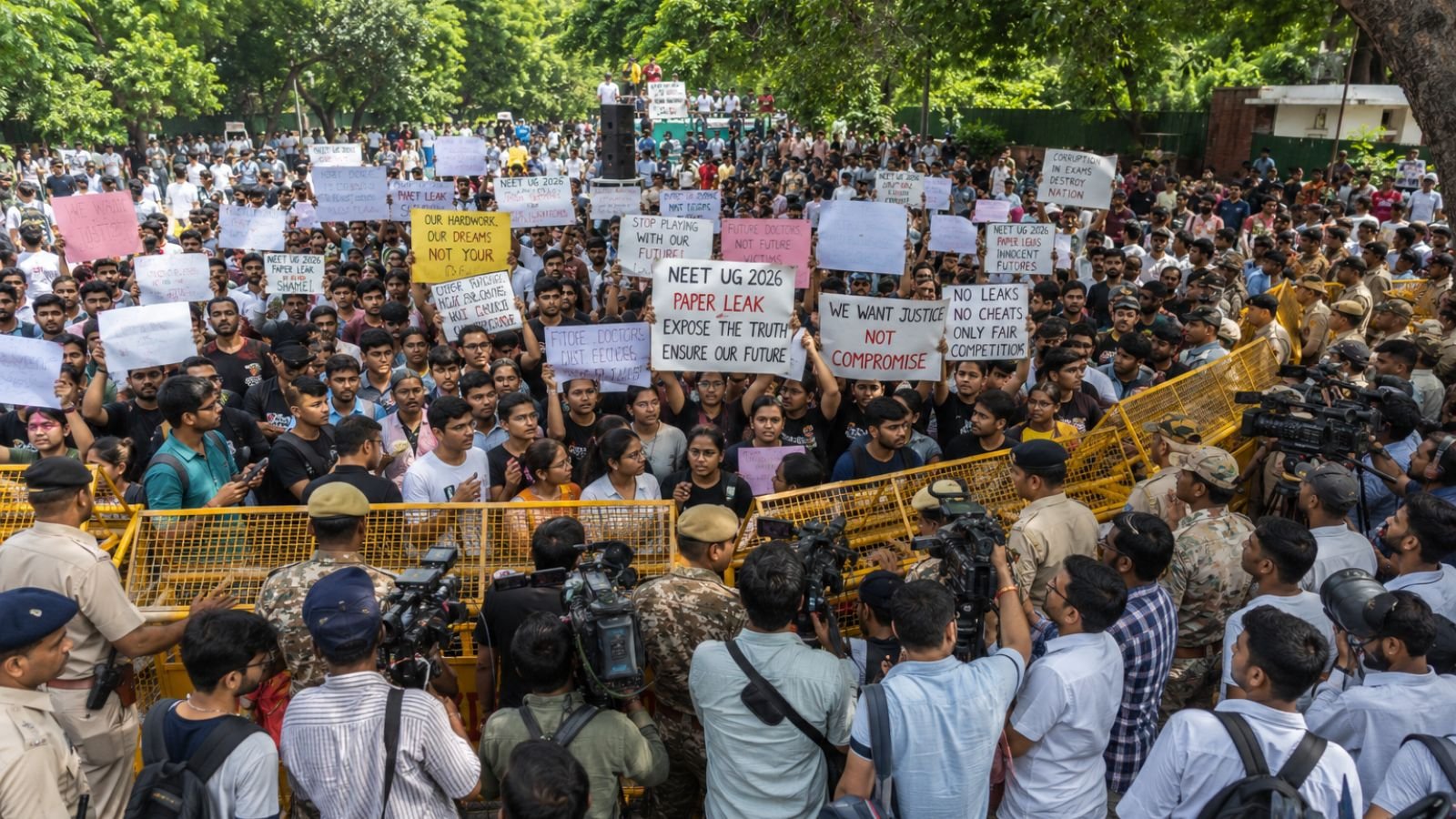
The NEET UG 2026 paper leak controversy has developed into a nationwide political and student-led crisis, with protests spreading across multiple states and continued political confrontation during the Monsoon Session of Parliament. As of July 23, 2026, the central point of the controversy remains the refusal of Union Education Minister Dharmendra Pradhan to resign despite growing demonstrations and demands from opposition parties and student organizations. What initially began as a localized student demonstration at Jantar Mantar has now expanded into a coordinated movement across several states. Student organizations, political parties, activists, and opposition leaders have intensified protests while the central government has outlined a series of structural reforms aimed at restoring confidence in the national examination system. The issue has become one of the most closely watched developments during the ongoing Monsoon Session.
Protests Expand Beyond Delhi
The movement first gained momentum through student demonstrations at Jantar Mantar in New Delhi before expanding into a multi-state agitation. Delhi remains the epicenter of the protests, where the Cockroach Janta Party together with student organizations and activist Sonam Wangchuk have continued large sit-ins at Jantar Mantar. The situation intensified after Delhi Police used tear gas during the Sansad Chalo march. The developments also resulted in the closure of sixteen Delhi Metro stations, highlighting the scale of the demonstrations taking place in the national capital. Political protests also extended into the Parliament complex at Makar Dwar, where opposition parties belonging to the INDIA Bloc, led by Rahul Gandhi and Sonia Gandhi, staged demonstrations during the Monsoon Session. The combination of student protests and political demonstrations has made Delhi the focal point of the nationwide movement.
Maharashtra Witnesses Growing Agitation
The protest movement has also expanded significantly in Maharashtra. Mumbai has emerged as another important center of demonstrations, where the Cockroach Janta Party organized protests at Azad Maidan in Dadar. Political leaders have also announced larger mobilization efforts in the state. Shiv Sena UBT leader Uddhav Thackeray and Maharashtra Navnirman Sena chief Raj Thackeray have jointly announced a large student and parent morcha in Mumbai scheduled for July 26. The planned march reflects the growing participation of political organizations alongside student groups in the ongoing movement.
Bihar Sees Legislative Demonstrations
The controversy has also reached Bihar, where opposition parties organized large demonstrations within the State Legislature premises in Patna. The protests coincided with the opening days of the Monsoon Session and focused on demanding the immediate removal of Union Education Minister Dharmendra Pradhan. The demonstrations in Bihar have further expanded the geographical reach of the movement while increasing political pressure surrounding the examination controversy.
Uttar Pradesh Reports Student Demonstrations
Reports from Uttar Pradesh indicate continued youth demonstrations and detentions connected with the protests. According to the available information, major clampdowns and detentions have been reported at Lucknow University. The protests have also spread into public squares across major student centers including Kota and Kanpur, reflecting wider participation by students and youth groups. The continued demonstrations show that the issue is no longer limited to one region and has become a broader national movement.
Multiple States Join the Protest Movement
Apart from Delhi, Maharashtra, Bihar, and Uttar Pradesh, synchronized protests led by student federations have been reported in several other states. According to the available information, demonstrations are currently active in:
- Karnataka (Bengaluru)
- Telangana (Hyderabad)
- West Bengal (Kolkata)
- Assam (Guwahati)
- Himachal Pradesh
The participation of multiple states illustrates how the issue has developed from a localized protest into a coordinated nationwide campaign.
Dharmendra Pradhan Breaks His Silence
After weeks of public silence, Union Education Minister Dharmendra Pradhan issued a detailed public address together with a series of late-night statements through his official X account. His response focused on the government’s position regarding the ongoing controversy while addressing questions surrounding his future as Education Minister. The statements also outlined the government’s approach toward examination reforms and parliamentary discussion.
Minister Rejects Calls for Resignation
One of the most significant announcements made by Dharmendra Pradhan was his refusal to resign. Government and ministry officials clearly stated that there was no question of resignation by the minister. According to the government’s position, Pradhan is not personally compromised and a re-test had already been successfully conducted. The statement represents the central government’s official position despite continued demands from protesters seeking his resignation.
Strong Criticism of the Opposition
Dharmendra Pradhan also strongly criticized opposition parties during his public response. He accused Rahul Gandhi and the Congress Party of exploiting students as political tools in order to generate media attention and disrupt the Parliamentary Monsoon Session. The minister further described the opposition’s flash dharna outside the Prime Minister’s residence as a violation of established security protocols. These remarks added another political dimension to the ongoing debate surrounding the examination controversy.
Government Commits to Parliamentary Debate
The Education Minister also reiterated the government’s commitment to discussing examination integrity within Parliament. According to his statement, the central government remains fully committed to conducting a comprehensive debate on exam integrity on the floor of the House. He also stated that the government had approached Lok Sabha Speaker Om Birla to facilitate a structured parliamentary discussion aimed at addressing students’ concerns through democratic procedures. The statement emphasized Parliament as the appropriate forum for discussing examination reforms.
Statement on Accountability
Dharmendra Pradhan also addressed the emotional impact of the controversy. He stated that students deserve answers, reforms, and accountability while expressing grief over student suicides. According to his remarks, he personally experiences deep sorrow whenever a student loses life because of pressure within the education system. The statement focused on acknowledging students’ concerns while reaffirming the government’s commitment to reform.
Government Announces Structural Reforms
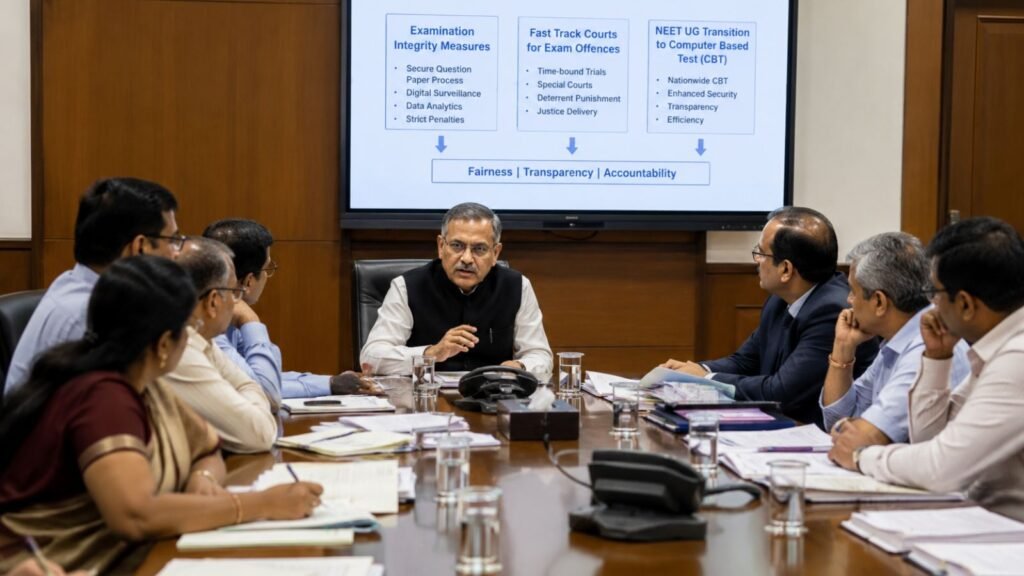
Alongside its response to the protests, the central government announced several structural initiatives designed to strengthen examination security.
- Fast Track Courts: Prime Minister Narendra Modi announced that dedicated fast track courts will be created to prosecute individuals and organized paper leak networks responsible for compromising national examinations
- Transition Towards Computer Based Testing: The Ministry of Education has begun preparing a roadmap for shifting the NEET UG examination entirely to a Computer Based Test format to eliminate risks associated with manual paper handling and reduce opportunities for paper leaks
Political and Student Movement Continues
Despite the government’s announcements regarding reforms and parliamentary discussion, protests continue across multiple states. Student organizations, political parties, and opposition leaders remain active in organizing demonstrations while continuing to demand accountability over the NEET UG 2026 paper leak controversy. At the same time, the central government continues to maintain that structural reforms, parliamentary debate, and judicial action against paper leak networks remain its primary response to the crisis.
Conclusion
The NEET UG 2026 paper leak controversy has evolved into one of the largest nationwide education-related movements in recent times. What began as student demonstrations at Jantar Mantar has expanded across Delhi, Maharashtra, Bihar, Uttar Pradesh, Karnataka, Telangana, West Bengal, Assam, and Himachal Pradesh. While protesters continue demanding accountability and the resignation of Union Education Minister Dharmendra Pradhan, the government has rejected calls for resignation and instead announced structural reforms including specialized fast track courts and a transition toward Computer Based Testing for future NEET UG examinations. As protests continue during the Monsoon Session of Parliament, the issue remains at the center of national political and educational debate.
Frequently Asked Questions
Q1. What is the main demand of the NEET UG 2026 protests?
A1. The main demand of the protesters is the immediate resignation of Union Education Minister Dharmendra Pradhan over the NEET UG 2026 paper leak controversy.
Q2. Which states have witnessed protests over the NEET UG paper leak?
A2. Protests have been reported in Delhi, Maharashtra, Bihar, Uttar Pradesh, Karnataka, Telangana, West Bengal, Assam, and Himachal Pradesh.
Q3. What was Dharmendra Pradhan’s response to the resignation demands?
A3. Dharmendra Pradhan refused to resign, stating that he is not personally compromised and that a re-test had already been successfully conducted.
Q4. What structural reforms has the government announced?
A4. The government has announced the creation of specialized fast track courts for paper leak cases and a transition towards Computer Based Testing for NEET UG examinations.
Q5. What is the status of parliamentary debate on the issue?
A5. The government has committed to a comprehensive debate on exam integrity in Parliament and has approached Lok Sabha Speaker Om Birla to facilitate structured discussion.