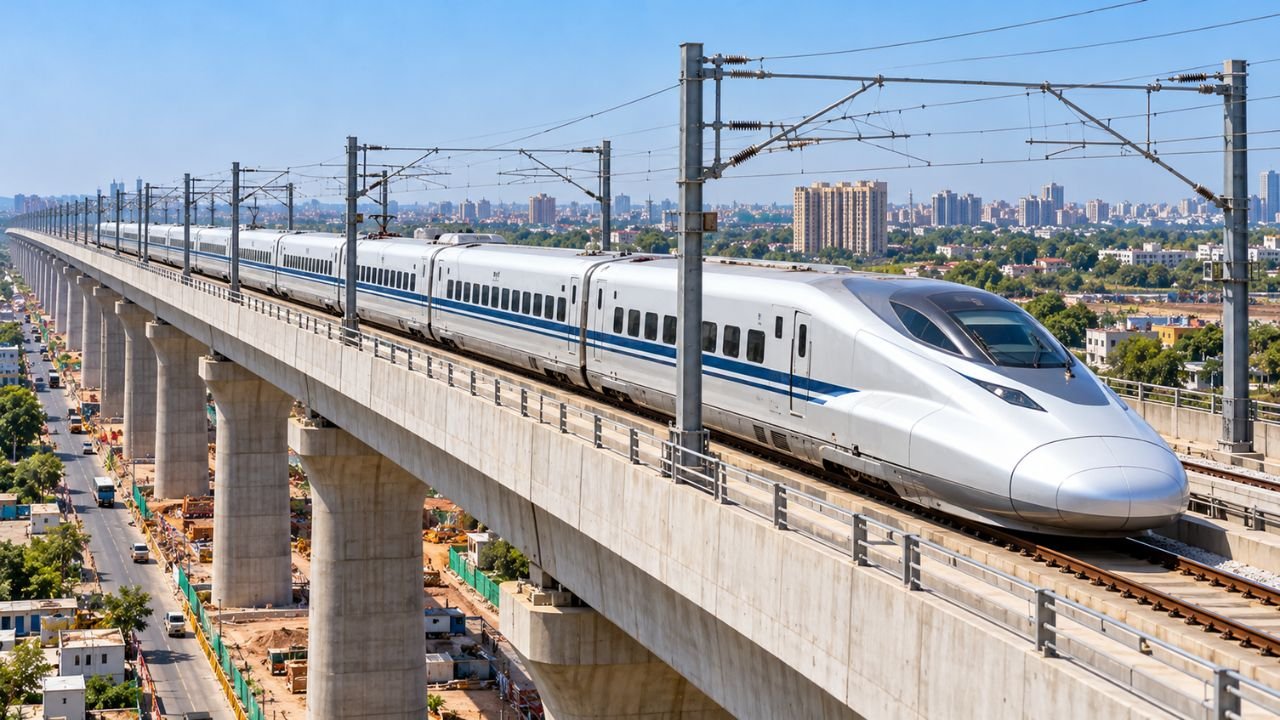
The Mumbai–Ahmedabad High-Speed Rail Corridor (MAHSR), popularly known as the Bullet Train project, is India’s first dedicated high-speed railway line. Developed by the National High Speed Rail Corporation Limited (NHSRCL) using Japanese Shinkansen technology, the project will connect Mumbai, India’s financial capital, with Ahmedabad, Gujarat’s commercial gateway. The project has crossed 62% physical progress, while 100% of the required land has been acquired. With major construction work advancing across viaducts, tunnels and railway systems, the corridor is planned to open in phases, beginning with the Surat-to-Bilimora section in Gujarat. Once complete, the project is expected to transform travel between the two cities, cutting a journey that currently takes around six hours by road down to under two hours.
Mumbai–Ahmedabad Bullet Train Project: Key Details
The high-speed rail corridor is designed to cover a total distance of 508.18 kilometres. It will have a design speed of 350 km/h and an operational speed of 320 km/h, significantly reducing travel time between Mumbai and Ahmedabad. The express service is expected to complete the journey in 1 hour and 58 minutes, while limited-stop services are expected to take 2 hours and 7 minutes. The project is being built at an estimated cost of ₹1,08,000 crore, and land acquisition has already been completed across the entire route.
| Project Detail | Information |
|---|---|
| Project Name | Mumbai–Ahmedabad High-Speed Rail Corridor (MAHSR) |
| Implementing Agency | National High Speed Rail Corporation Limited (NHSRCL) |
| Technology | Japanese Shinkansen |
| Total Distance | 508.18 kilometres |
| Design Speed | 350 km/h |
| Operational Speed | 320 km/h |
| Express Service Travel Time | 1 hour 58 minutes |
| Limited-Stop Service Travel Time | 2 hours 7 minutes |
| Estimated Project Cost | ₹1,08,000 crore |
| Land Acquisition | 100% completed |
| Physical Progress | More than 62% |
The project is expected to reduce the current six-hour road journey between Mumbai and Ahmedabad to 1 hour and 58 minutes for express services. Services with limited stops are expected to complete the journey in 2 hours and 7 minutes. This reduction in travel time is one of the biggest reasons the project has drawn so much attention from commuters, businesses and policymakers alike.
Mumbai–Ahmedabad Bullet Train Route and Stations
The corridor will include 12 stations, connecting important cities and commercial centres across Maharashtra and Gujarat. The route is planned to pass through Mumbai, Thane, Virar, Boisar, Vapi, Bilimora, Surat, Bharuch, Vadodara, Anand, Ahmedabad and Sabarmati. Each station has been selected to serve a major urban or commercial centre along the route, giving the corridor wide coverage across both states.
The planned station list is as follows:
- Mumbai (BKC)
- Thane
- Virar
- Boisar
- Vapi
- Bilimora
- Surat
- Bharuch
- Vadodara
- Anand
- Ahmedabad
- Sabarmati
These stations will connect major urban centres along the corridor, with several stations located in Gujarat. Surat and Bilimora are particularly important to the first planned operational phase in the state. The station at Mumbai BKC is expected to serve as a key entry point for travellers from Mumbai’s business district, while Sabarmati will connect the corridor to Ahmedabad’s growing transport network.
Latest Construction Progress and Engineering Milestones
Construction work on the Mumbai–Ahmedabad Bullet Train project includes elevated viaducts, railway foundations, underground tunnels and specialised track systems. Major engineering activities have advanced across different sections of the corridor, bringing the project closer to its first operational phase.
Viaducts and Piers
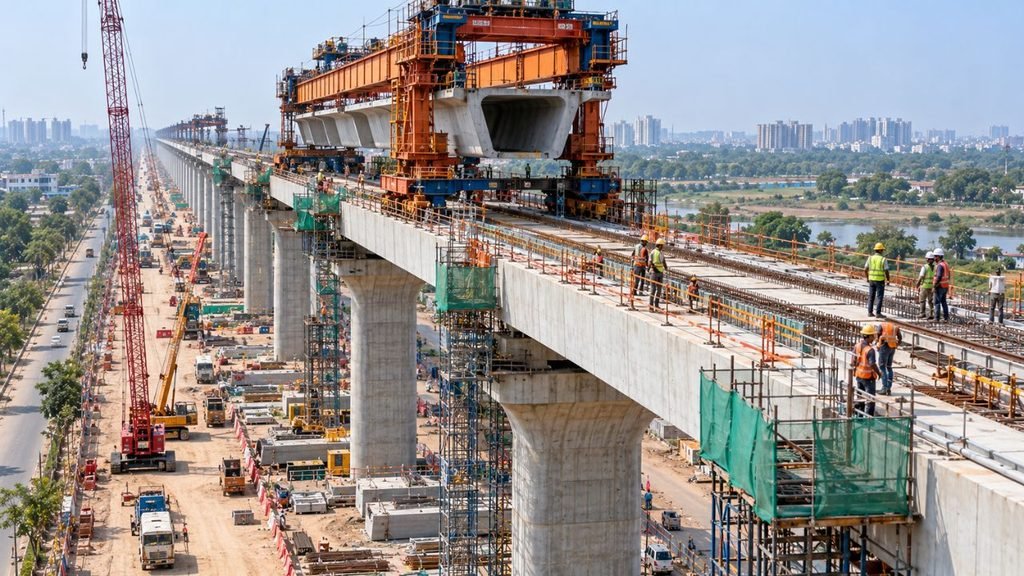
Foundation work has extended across more than 459 kilometres, while 371 kilometres of viaduct girders have already been erected. The project is using the Full Span Launching Method (FSLM) to accelerate the bridge-construction process. These elevated structures form a major part of the railway corridor and represent an important stage in the project’s physical development. The use of FSLM allows large spans to be launched quickly, which speeds up construction without compromising quality.
Vadodara Bottleneck Cleared
A major construction milestone was achieved in Vadodara with the installation of all 14 portal beams directly over the busy and operational Delhi–Mumbai Rajdhani main line. Completing this work represents progress at a particularly challenging section of the corridor. Since the Rajdhani line remains operational, the work had to be carried out without disrupting existing train services, making this a technically demanding achievement.
Undersea and Mountain Tunnels
The route includes a 21-kilometre underground stretch in Maharashtra, featuring India’s first 7-kilometre undersea rail tunnel beneath Thane Creek. Tunnel excavation is being carried out using Tunnel Boring Machines (TBMs) measuring 13.6 metres in diameter. Excavation has also been completed for four of the eight planned mountain tunnels. These underground sections are important components of the corridor’s overall construction and will allow the high-speed line to pass through difficult terrain without affecting surface infrastructure.
Track and Railway Systems
More than 97 route kilometres of specialised ballastless track slabs have been laid. Thousands of Over-Head Equipment (OHE) masts have also been installed as part of the railway systems work. Together, the viaducts, tunnels, track slabs and overhead equipment represent several key elements of the high-speed rail infrastructure. Each of these components plays a specific role in ensuring that trains can run safely and smoothly at speeds of up to 320 km/h.
Mumbai–Ahmedabad Bullet Train Project Cost and Funding
The estimated cost of the Mumbai–Ahmedabad High-Speed Rail Corridor is ₹1,08,000 crore. Around 81% of the project funding is being provided through a 50-year soft loan from the Japan International Cooperation Agency (JICA). The funding structure supports the development of the high-speed railway using Japanese Shinkansen technology. The project involves extensive civil engineering, specialised railway systems and major infrastructure works along its 508.18-kilometre route. The long repayment period and concessional terms of the JICA loan help make such a large infrastructure project financially manageable for India.
Mumbai–Ahmedabad Bullet Train Launch Timeline
The project is planned to become operational in phases rather than opening the entire corridor at once. The initial phase is focused on the Gujarat section, followed by further track completion and the eventual activation of the full route. This phased approach allows the authorities to begin operations on completed sections while construction continues elsewhere.
| Project Phase | Target Date | Planned Development |
|---|---|---|
| First Trial and Operational Run | August 2027 | Surat-to-Bilimora section, with an extension to Vapi, targeted to open on August 15, 2027 |
| Gujarat Stretch | December 2027 | Completion of the track between Vapi and Sabarmati |
| Full Corridor Activation | 2029 | The entire 508-kilometre line from Mumbai BKC to Sabarmati is expected to become fully functional |
First Phase: Surat to Bilimora
The first trial and operational run is targeted for August 2027. The Surat-to-Bilimora section, with an extension to Vapi, is planned to open to the public on August 15, 2027. This phase will give passengers in Gujarat a first taste of high-speed rail travel and allow authorities to test systems in real operating conditions.
Gujarat Stretch: December 2027
The next milestone is the completion of the track between Vapi and Sabarmati in December 2027. This phase will extend the operational railway infrastructure across a larger part of Gujarat, connecting more cities and bringing the corridor closer to full completion.
Full Corridor: 2029
The entire 508-kilometre corridor connecting Mumbai BKC with Sabarmati is expected to become fully functional by 2029. This represents the planned final stage of the project’s phased launch, when passengers will be able to travel the full route between Mumbai and Ahmedabad on the high-speed line.
What the Bullet Train Project Means for Gujarat
The Mumbai–Ahmedabad Bullet Train corridor will connect several important Gujarat cities, including Vapi, Bilimora, Surat, Bharuch, Vadodara, Anand, Ahmedabad and Sabarmati. Its phased launch plan places the Surat-to-Bilimora section at the centre of the initial operational stage. With more than 62% physical progress reported and land acquisition completed, construction continues across viaducts, tunnels, tracks and railway systems. The planned milestones for August 2027, December 2027 and 2029 outline the route towards phased operations. For Gujarat, the project is expected to boost business travel, tourism and regional connectivity, while also creating new opportunities around the stations along the corridor.
Conclusion
The Mumbai–Ahmedabad Bullet Train project is progressing through major construction and engineering stages, with a planned route of 508.18 kilometres and an operational speed of 320 km/h. The project aims to reduce express-service travel time between Mumbai and Ahmedabad to 1 hour and 58 minutes. The first operational phase is targeted for August 15, 2027, on the Surat-to-Bilimora section, with an extension to Vapi. The Gujarat stretch is planned for completion in December 2027, while the full corridor is expected to become functional by 2029. With 100% land acquisition complete and more than 62% physical progress achieved, the project continues to move forward as one of India’s most significant infrastructure initiatives.
Frequently Asked Questions
Q1. What is the Mumbai–Ahmedabad Bullet Train project?
A1. It is India’s first dedicated high-speed rail corridor, developed by NHSRCL using Japanese Shinkansen technology, connecting Mumbai and Ahmedabad over a distance of 508.18 kilometres.
Q2. What is the travel time between Mumbai and Ahmedabad on the Bullet Train?
A2. Express services are expected to complete the journey in 1 hour and 58 minutes, while limited-stop services are expected to take 2 hours and 7 minutes.
Q3. Which stations are planned on the Mumbai–Ahmedabad Bullet Train route?
A3. The 12 planned stations are Mumbai (BKC), Thane, Virar, Boisar, Vapi, Bilimora, Surat, Bharuch, Vadodara, Anand, Ahmedabad and Sabarmati.
Q4. When will the Mumbai–Ahmedabad Bullet Train start operations?
A4. The first operational phase is targeted for August 15, 2027, on the Surat-to-Bilimora section with an extension to Vapi. The Gujarat stretch is planned for completion in December 2027, and the full corridor is expected to become functional by 2029.
Q5. What is the estimated cost and funding of the project?
A5. The estimated cost is ₹1,08,000 crore, with around 81% of the funding provided through a 50-year soft loan from the Japan International Cooperation Agency (JICA).