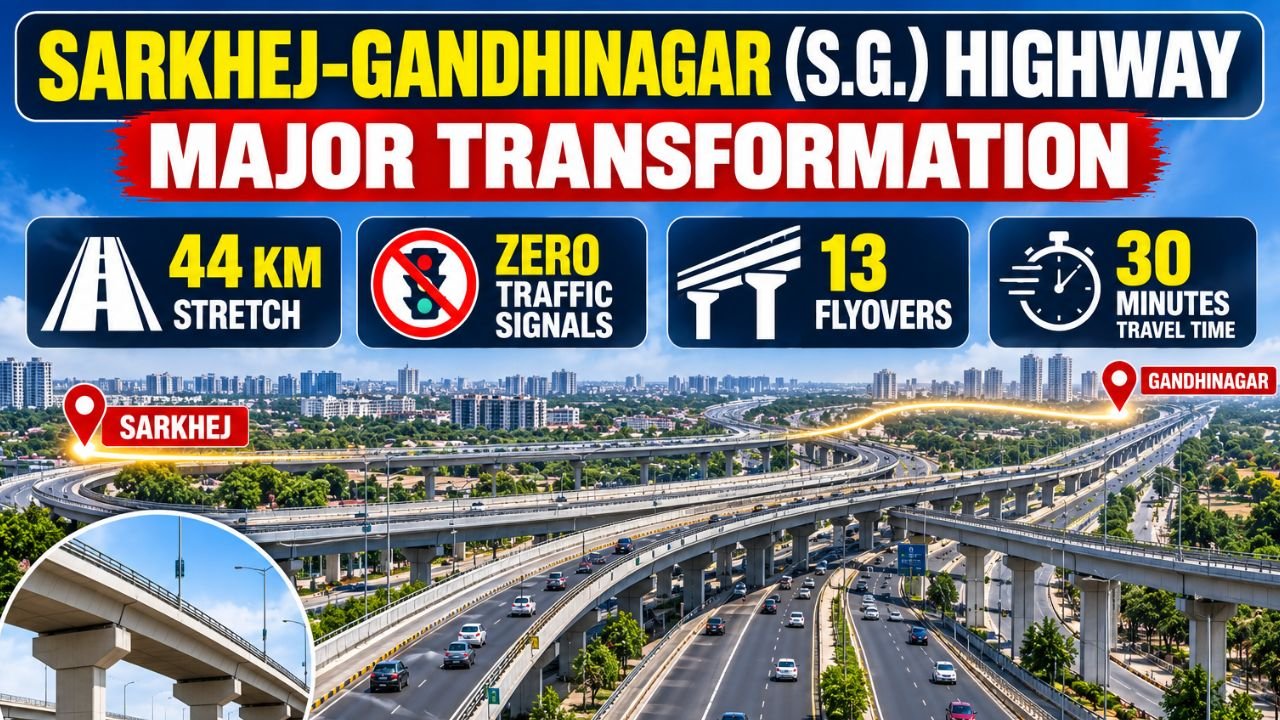
The Sarkhej–Gandhinagar (S.G.) Highway is undergoing a major infrastructure transformation aimed at creating Gujarat’s first signal-free, zero-traffic-signal corridor. The project covers a 44 km stretch from Sarkhej to Chiloda and includes a network of 13 prominent flyovers and elevated structures. Managed jointly by the National Highways Authority of India (NHAI) and the state’s Roads and Buildings Department, the upgrade aims to reduce congestion and bring travel time between Ahmedabad and Gandhinagar down to just 30 minutes. With several flyover sections completed or approaching completion, the project is expected to improve connectivity across important parts of Ahmedabad and provide smoother journeys for daily commuters. For anyone who travels this route regularly, the changes are already beginning to show, and the full impact will be felt as more sections open to traffic.
S.G. Highway Project: Key Details
The highway transformation includes several major features that together aim to create a continuous, uninterrupted driving experience.
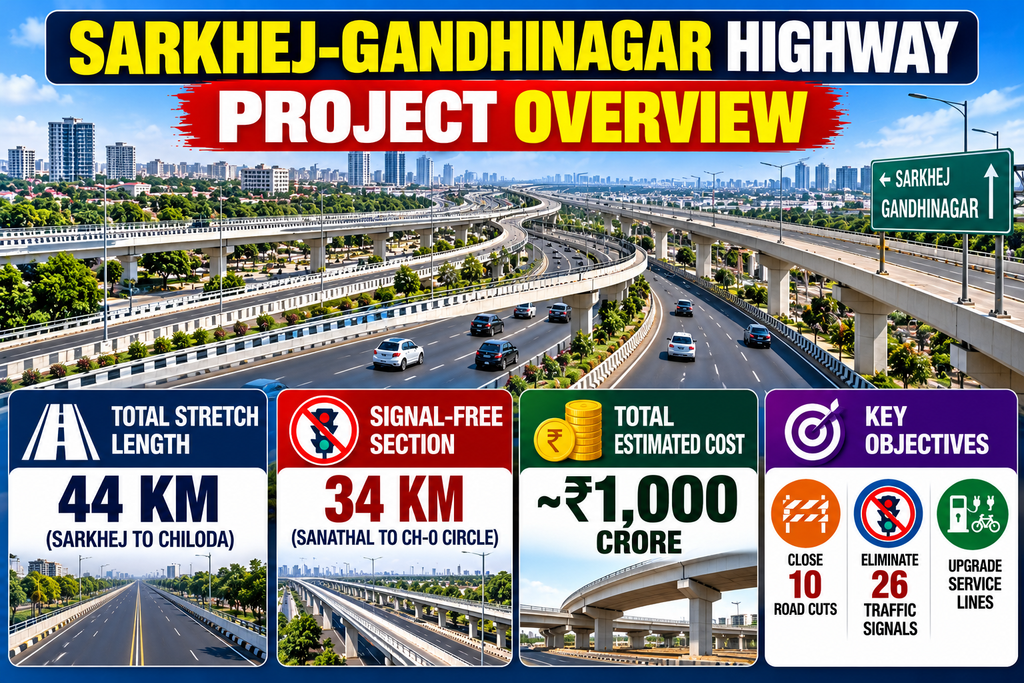
| Project Detail | Information |
|---|---|
| Total highway stretch | 44 km, from Sarkhej to Chiloda |
| Signal-free section | 34 km, from Sanathal to CH-0 Circle |
| Estimated project cost | Approximately ₹1,000 crore |
| Flyovers and elevated structures | 13 prominent structures |
| Main objectives | Close 10 existing road cuts, eliminate 26 traffic signals or junctions and upgrade service lines |
| Planned amenities | EV charging and cycle tracks |
| Target travel time | 30 minutes between Ahmedabad and Gandhinagar |
The project aims to create a more continuous road network by connecting existing elevated corridors with newly constructed sections. It also includes improvements to service lines and the introduction of additional amenities. By closing road cuts and removing signals, the highway is being redesigned to keep traffic moving rather than stopping at every junction.
Major Flyover Projects on the S.G. Highway
Several important sections are either operational or in the final stages of construction. Each of these flyovers plays a specific role in the wider plan to make the highway signal-free.
1. ISKCON to Sanand Circle Elevated Corridor
The ISKCON to Sanand Circle elevated corridor is already completed and operational. It opened in July 2026 and provides a six-lane elevated route designed to help vehicles bypass heavily congested junctions.
- Length: 4 km
- Configuration: Six-lane elevated corridor
- Construction cost: ₹500 crore
- Status: Completed and operational
The corridor allows nearly 2 lakh vehicles daily to bypass congested junctions, including Karnavati Club, Prahladnagar and YMCA Club. This is an important part of the wider effort to improve traffic movement along the highway. Commuters who use this stretch regularly have already reported a noticeable difference in travel time since the corridor opened.
2. YMCA to Karnavati Club Flyover
The YMCA to Karnavati Club flyover is in its final construction stage, with an opening expected by Diwali 2026. The project includes a 1.2 km-long, six-lane elevated corridor that connects directly with the larger Sarkhej-to-ISKCON highway network. Once operational, it is expected to ease peak-hour traffic pressure for more than 1.5 lakh daily commuters.
Construction briefly encountered an obstacle at Pillar P-27 because an Ahmedabad Municipal Corporation (AMC) water trunk pipeline overlapped with the project. The pipeline required relocation. Despite this challenge, the project has moved forward and is now close to completion.
3. Gota Crossroads to Nirma University Flyover
The Gota Crossroads to Nirma University flyover is under advanced construction, with completion targeted for late 2026. The project details are:
- Length: 2.09 km
- Configuration: Four-lane flyover
- Investment: More than ₹60 crore
- Status: Under advanced construction
The flyover is designed to bypass the heavily congested Jagatpur and Chharodi junctions. It aims to make journeys towards Nirma University, Vaishnodevi Circle and Gandhinagar smoother and less interrupted. Students, faculty and daily commuters who use this route will benefit once the flyover opens.
Connecting Existing and New Elevated Corridors
The highway upgrade also connects newer construction sections with existing infrastructure, including the previously inaugurated 2.36 km Gota-to-Science City elevated bridge. By bringing these corridors together, the project aims to create a more continuous elevated transit route across Ahmedabad. The wider network is designed to reduce traffic interruptions, improve road connectivity and support smoother movement between key destinations. When all sections are linked, drivers will be able to travel longer distances without stopping at signals, which is the core goal of the entire project.
How the Highway Upgrade Could Benefit Commuters
The S.G. Highway transformation focuses on reducing delays caused by busy junctions and traffic signals. Closing 10 existing road cuts and eliminating 26 traffic signals or junctions are among the project’s key objectives. The planned EV charging facilities and cycle tracks are also part of the service-line upgrades. Together, these improvements aim to provide a more connected and efficient road network along the Sarkhej-to-Chiloda stretch.
With the ISKCON-to-Sanand Circle corridor already operational and other flyovers progressing towards completion, the project is moving towards its broader goal of a signal-free highway corridor. For daily commuters, this means fewer stops, less fuel consumption and a more predictable travel time between Ahmedabad and Gandhinagar.
Conclusion
The S.G. Highway upgrade is a major road infrastructure project connecting Sarkhej and Chiloda across a 44 km stretch. With 13 prominent flyovers and elevated structures, an estimated cost of approximately ₹1,000 crore and a 34 km signal-free section planned from Sanathal to CH-0 Circle, the project aims to reduce congestion and improve travel between Ahmedabad and Gandhinagar. As the YMCA-to-Karnavati Club and Gota-to-Nirma University flyovers progress, the wider network is intended to make daily journeys smoother and help reduce travel time to around 30 minutes. For a city that depends heavily on road connectivity, this upgrade represents one of the most significant infrastructure improvements in recent years.
Frequently Asked Questions
Q1. What is the S.G. Highway upgrade project?
A1. It is a major infrastructure project covering a 44 km stretch from Sarkhej to Chiloda, aimed at creating Gujarat’s first signal-free corridor with 13 flyovers and elevated structures, reducing travel time between Ahmedabad and Gandhinagar to around 30 minutes.
Q2. How many flyovers are being built on the S.G. Highway?
A2. The project includes 13 prominent flyovers and elevated structures. Key ones include the ISKCON to Sanand Circle elevated corridor, the YMCA to Karnavati Club flyover and the Gota Crossroads to Nirma University flyover.
Q3. What is the cost of the S.G. Highway upgrade?
A3. The estimated project cost is approximately ₹1,000 crore. The ISKCON to Sanand Circle elevated corridor alone cost ₹500 crore, while the Gota Crossroads to Nirma University flyover involves an investment of more than ₹60 crore.
Q4. What are the main objectives of the S.G. Highway upgrade?
A4. The main objectives include closing 10 existing road cuts, eliminating 26 traffic signals or junctions, upgrading service lines, adding EV charging and cycle tracks, and creating a 34 km signal-free section from Sanathal to CH-0 Circle.
Q5. When will the YMCA to Karnavati Club flyover open?
A5. The YMCA to Karnavati Club flyover is in its final construction stage, with an opening expected by Diwali 2026. It is a 1.2 km-long, six-lane elevated corridor that will connect directly with the larger Sarkhej-to-ISKCON highway network.