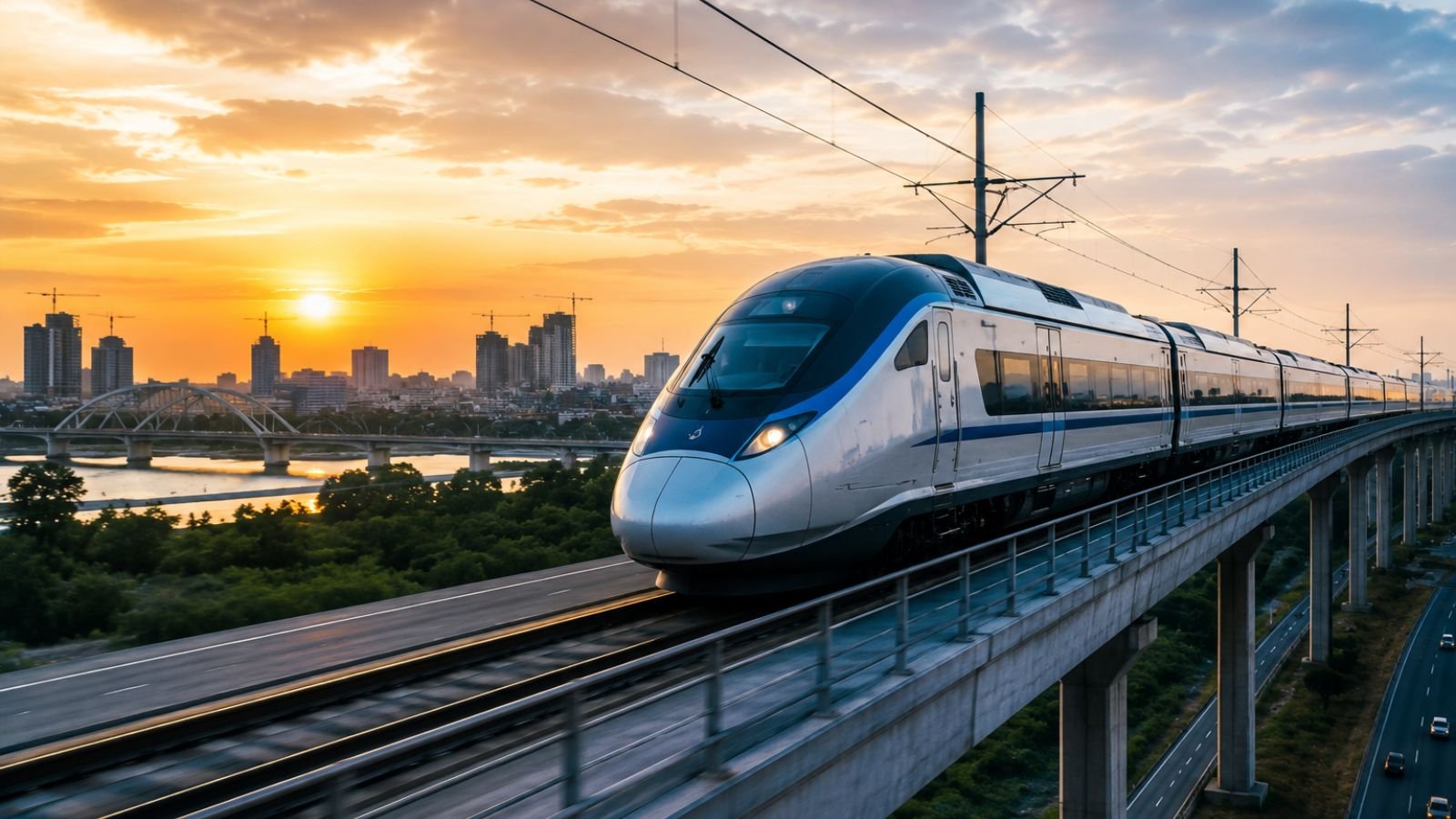
The Cabinet Committee on Economic Affairs (CCEA) has officially approved the ₹20,667 crore Ahmedabad (Sarkhej) to Dholera Semi High-Speed Rail Corridor, marking a historic milestone for Indian Railways. According to the provided information, this is India’s first-ever semi high-speed rail project designed entirely using indigenously developed technology. The 134 km double-line broad-gauge corridor is expected to become a model project for future regional high-speed rail expansion across the country. The project is designed to significantly improve passenger mobility, industrial logistics, airport access, metro integration, and regional connectivity between Ahmedabad and the rapidly developing Dholera Special Investment Region (SIR).
Ahmedabad–Dholera Rail Corridor Overview
The newly approved semi high-speed corridor will connect Sarkhej (Ahmedabad) to Dholera. The project includes double-line broad-gauge rail infrastructure, semi high-speed train operations, multi-modal transport integration, industrial freight connectivity, and airport rail integration. The project will serve as a nationwide benchmark for future indigenous regional high-speed rail systems.
Total Project Cost
The estimated cost of the project is ₹20,667 Crore. The large-scale investment reflects the importance of the corridor in industrial development, transportation modernization, urban expansion, and regional economic growth.
Track Length and Infrastructure Details
The rail corridor will feature a 134 km double-line route. Additional infrastructure includes 293 km total track coverage, 74 km elevated viaduct structures, and 13 stations along the route. The project combines modern passenger transit with industrial logistics connectivity.
Semi High-Speed Train Speed Details
- Maximum Design Speed: 220 kmph
- Operational Speed: 200 kmph
This places the corridor among India’s fastest regional rail systems outside the dedicated bullet train network. The reduced travel time is expected to completely transform commuting between Ahmedabad and Dholera.
Ahmedabad to Dholera Travel Time Reduction
The corridor is expected to reduce Sarkhej to Dholera travel time to approximately 34 minutes. This would allow faster business travel, daily commuting possibilities, same-day industrial operations, and airport accessibility improvements.
Completion Timeline
Target completion period is the 2030–31 Financial Year. The corridor is expected to become operational after phased infrastructure completion and station integration.
Why This Project Is Important for India
The project is being viewed as India’s first indigenous semi high-speed rail corridor. Unlike imported technology-based systems, this route is designed around indigenous railway modernization, domestic engineering capability, and Indian transport integration systems. The corridor is expected to become a template for future regional rail modernization projects.
Major Industrial and Regional Impact
Dholera SIR Connectivity Boost
The corridor will directly strengthen Dholera Special Investment Region (SIR). The route will connect industrial clusters with the Delhi–Mumbai Industrial Corridor (DMIC), accelerating manufacturing growth, industrial transportation, supply chain movement, and regional investment expansion.
Multi-Modal Transport Integration
The project has been designed under the PM-Gati Shakti National Master Plan. The corridor will integrate with Dholera International Airport, National Hi-Speed Manufacturing Cluster, Ahmedabad Metro, freight infrastructure, and tourism zones. This integration approach is aimed at seamless passenger and logistics movement.
Rural Connectivity Benefits
The corridor is expected to improve accessibility for 284 villages. Nearly 5 lakh residents will be directly impacted by improved regional transportation and mobility. The project could significantly improve daily travel access, economic participation, and regional development opportunities.
Green and Sustainable Transport Impact
The project may reduce oil imports by approximately 0.48 crore litres and lower carbon dioxide emissions by nearly 2 crore kg, positioning the corridor as environmentally sustainable rail infrastructure.
Advanced Technology and Safety Systems
- Indigenous modernization systems: Support for Namo Bharat trains
- Kavach 5.0 Safety System: Designed for automated train protection, collision prevention, and advanced railway safety standards
- Potential Namo Bharat Train Support: Could provide high-speed regional passenger movement, faster urban-industrial connectivity, and modern commuter transit solutions
Key Stations Planned Along the Route
- Sabarmati Terminal: Connect with Mumbai–Ahmedabad Bullet Train Corridor and integrate with Ahmedabad Metro. Will likely become a major inter-state transit hub.
- Sarkhej Station: Primary main-line starting hub for the semi high-speed corridor.
- Gandhigram and Vastrapur Stations: Planned for Ahmedabad Metro integration for fast urban dispersal and easy city commuting.
- Moriya and Vatva Connectivity: Connect directly with Western Dedicated Freight Corridor (DFC) for cargo movement, industrial logistics, and supply chain transportation.
- Dholka Junction: Critical intermediate regional station supporting rural connectivity, regional commuting, and local transport access.
- Lothal Junction: Designed to improve access to Lothal National Maritime Heritage Complex (NMHC), strengthening tourism movement, historical site access, and cultural infrastructure connectivity.
- Dholera International Airport Station: Directly integrate with Dholera International Airport for seamless air-to-rail transfers.
- Dholera SIR Smart City Station: Final terminal area serving Dholera Smart City and industrial zones including semiconductor parks, high-tech manufacturing zones, and industrial parks.
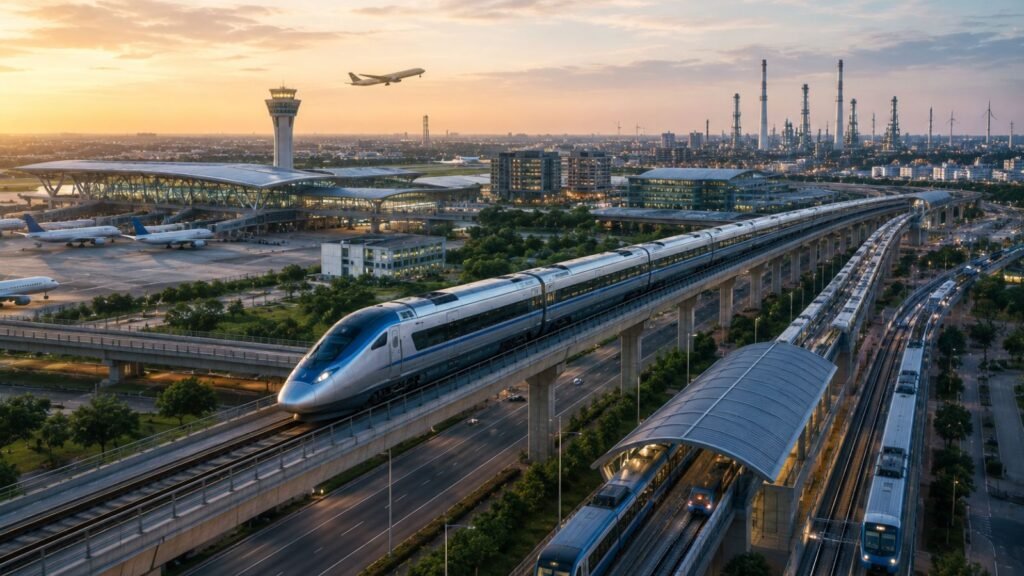
Multi-Modal Connectivity Matrix
- Sabarmati Integration: Connects Mumbai–Ahmedabad High-Speed Rail and Ahmedabad Metro for inter-state connectivity.
- Gandhigram and Vastrapur Integration: Integrates with Ahmedabad Metro Phase Network for instant city movement and urban commuting support.
- Moriya Freight Integration: Connects directly with Dedicated Freight Corridor (DFC) for cargo transportation and industrial supply chains.
- Dholera Airport Integration: Supports aviation transit infrastructure for passenger movement, airport accessibility, and air-rail coordination.
Estimated Travel Time Between Key Points
- Sarkhej to Dholera Airport: Approximately 34–38 minutes
- Sabarmati Terminal to Dholera SIR: Approximately 48 minutes
Why the Ahmedabad–Dholera Corridor Matters
The project combines indigenous railway technology, semi high-speed operations, industrial integration, airport connectivity, green infrastructure goals, metro coordination, and freight corridor access. It represents a major transition toward next-generation regional rail systems in India.
Conclusion
The Ahmedabad (Sarkhej) to Dholera Semi High-Speed Rail Corridor has officially received approval from the Cabinet Committee on Economic Affairs (CCEA), with an estimated project cost of ₹20,667 crore. According to the provided information, the 134 km indigenous semi high-speed rail network will support train speeds up to 220 kmph and operational speeds of 200 kmph while reducing travel time between Ahmedabad and Dholera to nearly 34 minutes. The project is expected to transform Gujarat’s industrial transportation ecosystem through integration with Dholera SIR, Dedicated Freight Corridors, Ahmedabad Metro, Dholera International Airport, and future smart manufacturing zones. With modern safety systems like Kavach 5.0, possible Namo Bharat train compatibility, and strong environmental sustainability goals, the Ahmedabad–Dholera corridor is being positioned as a landmark rail modernization project and a future model for India’s regional high-speed transport expansion.
Frequently Asked Questions
Q1. What is the cost of the Ahmedabad–Dholera Semi High-Speed Rail Corridor?
A1. The estimated project cost is ₹20,667 crore.
Q2. What is the length of the Ahmedabad–Dholera rail corridor?
A2. The corridor will feature a 134 km double-line broad-gauge route.
Q3. What is the operational speed of trains on this corridor?
A3. The operational speed is 200 kmph, with a maximum design speed of 220 kmph.
Q4. What is the expected travel time from Sarkhej to Dholera Airport?
A4. The expected travel time is approximately 34 to 38 minutes.
Q5. When is the project expected to be completed?
A5. The target completion period is the 2030–31 financial year.