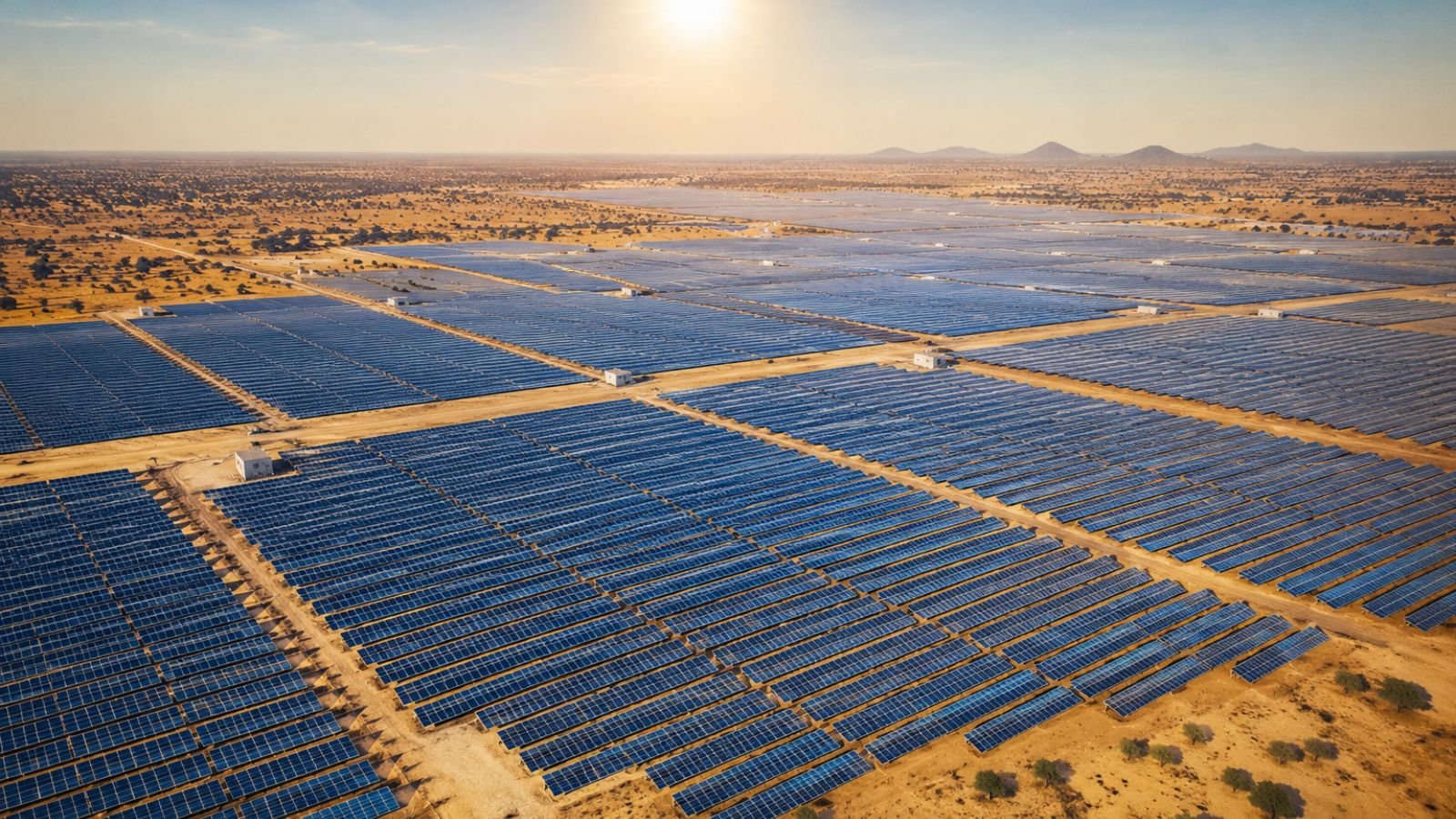
India renewable energy sector has achieved a historic global milestone through the Bhadla Solar Park in Rajasthan. According to the provided information, the Bhadla Solar Park is officially the largest solar power plant in the world, covering more than 14,000 acres across the Jodhpur district in Rajasthan, India. Located in the arid Thar Desert region near Phalodi Tehsil, the utility scale renewable energy project represents one of the most ambitious clean energy developments ever constructed. With a massive total operational capacity of 2,245 Megawatts (MW), the project has become a symbol of India growing leadership in global renewable energy generation.
What Is Bhadla Solar Park?
Bhadla Solar Park is a large scale solar energy infrastructure project located in Rajasthan Jodhpur district. According to the provided information, the project spans 56 square kilometers which equals approximately 14,000 acres. It is situated inside the Thar Desert region. The total operational capacity stands at 2,245 MW. The park was specifically developed in a high radiation desert zone to maximize solar power generation throughout the year.
Key Project Statistics of Bhadla Solar Park
The provided information highlights several major statistics about the solar project.
- Total Capacity: 2,245 Megawatts (MW), making it the world largest operational solar power plant by installed capacity
- Investment Value: More than 1.3 billion US dollars, with financing estimates also exceeding 1.4 billion US dollars, approximately 9,850 crore Indian rupees
- Project Footprint: 56 square kilometers, approximately 14,000 acres
The massive investment reflects the scale of infrastructure, land preparation, transmission systems, and solar panel deployment required for the project.
Why Rajasthan Was Chosen for the Project
According to the provided content, the site selection was based on multiple strategic and environmental advantages.
- High Solar Insolation: The region receives more than 300 clear sunny days every year, providing continuous exposure to strong solar radiation
- Perfect Desert Environment: The desert region was considered ideal because the land is largely uninhabited, agricultural value is minimal, and large solar panel arrays can be installed efficiently
- Extreme Heat Conditions: The area regularly experiences temperatures between 46°C and 48°C during summer, indicating extremely strong sunlight availability for solar generation
- Arid Topography Challenges: The Thar Desert environment also introduced difficulties such as high winds, heavy dust accumulation, and sand buildup on solar panels
Phase Wise Development of Bhadla Solar Park
The provided information states that the project was systematically developed across four major phases.
| Phase | Capacity | Development Agency | Engineering Contractors |
|---|---|---|---|
| Phase I | 65 MW | Rajasthan Solar Park Development Company Ltd (RSPDCL) | Rays Power Experts |
| Phase II | 680 MW | Rajasthan Solar Park Development Company Ltd (RSPDCL) | Vikram Solar, Rays Power Experts |
| Phase III | 1,000 MW | Saurya Urja Company of Rajasthan Ltd (SUCRL) | Larsen & Toubro (L&T), SB Energy |
| Phase IV | 500 MW | Adani Renewable Energy Park Rajasthan Ltd | Adani Green Energy, Ecoppia |
Financing Structure Behind the Mega Project
The provided information highlights the international and domestic funding structure used for the project.
- Climate Investment Funds (CIF): 775 million US dollars was provided through the Clean Technology Fund, forming one of the largest financial foundations supporting the project
- Asian Development Bank (ADB): The ADB reportedly helped finance low interest infrastructure loans and institutional transmission grids
- Commercial Banking Support: IDBI Bank and other commercial lending groups helped structure project debt and infrastructure financing
Technological Infrastructure of Bhadla Solar Park
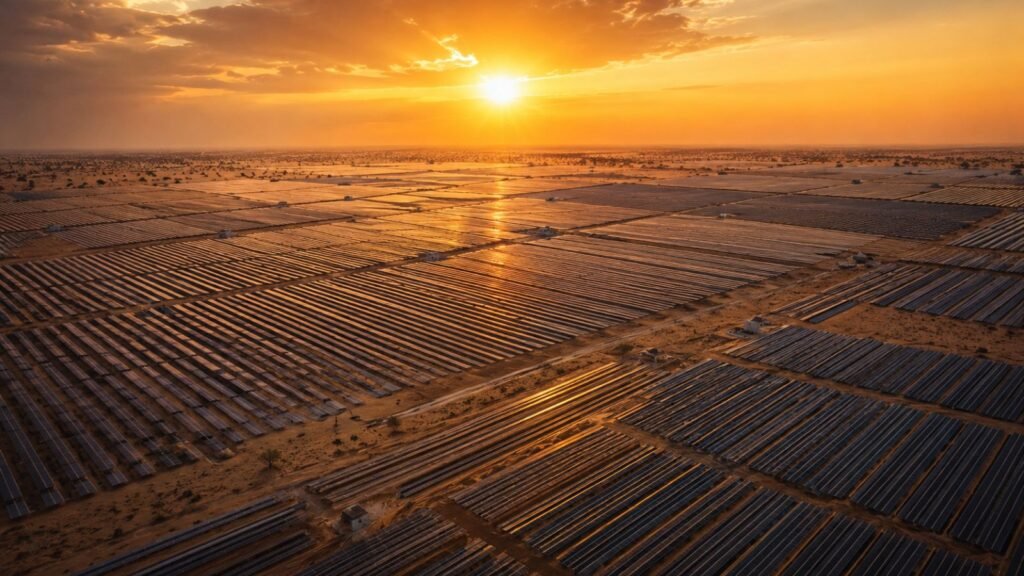
One of the most remarkable aspects of the project is its advanced technological infrastructure. The provided information states that the park operates more than 10 million solar panels. Managing such a massive solar array inside a hostile desert environment required advanced automation systems.
Waterless Robotic Cleaning System
Dust and sand accumulation can significantly reduce solar power generation efficiency. To solve this issue, over 2,000 automated Ecoppia water free robots were deployed. These robots clean panels nightly, use microfiber wipers, rely on airflow systems, and operate without water consumption. The provided information notes that this system helps save billions of liters of water in Rajasthan drought prone region.
High Voltage Power Evacuation Grid
Electricity generated from the solar arrays is routed through dedicated pooling stations and high voltage evacuation infrastructure. The power is then transferred through a central 400 kV pooling grid transmission line. This transmission system is managed by Power Grid Corporation of India (PGCIL).
Historic Solar Tariff Achievement
According to the provided information, Bhadla Solar Park became internationally famous for lowering solar energy prices in India. In late 2017 auctions, the project recorded a solar tariff of 2.44 rupees per kWh. The information explains that this demonstrated utility scale solar energy could become cheaper than traditional coal based electricity generation. This became one of the landmark moments in India renewable energy transformation.
Environmental Impact of Bhadla Solar Park
The project also delivers major environmental and energy sustainability benefits.
- Electricity Generation: The park generates approximately 732,874 Megawatt hours (MWh) of electricity annually
- Carbon Emission Reduction: The project offsets approximately 4 million tons of CO2 emissions every year
- Residential Power Supply Impact: The park supplies enough electricity to power approximately 4.5 million residential homes
Strategic Importance for India
According to the provided information, the project reinforces India leadership in utility scale clean energy, strengthens renewable infrastructure capacity, and supports long term energy transition goals. The park has also become an example of large scale desert solar deployment, climate focused financing, and renewable energy cost optimization.
Engineering Challenges Faced by the Project
Despite its success, the project had to overcome multiple environmental and operational challenges including extreme heat, high dust levels, sand accumulation, hostile desert winds, and infrastructure transmission requirements. The adoption of robotic cleaning technology and high voltage evacuation systems became essential for maintaining operational efficiency.
Why Bhadla Solar Park Is Globally Significant
The provided information reflects why Bhadla Solar Park is considered one of the world most important renewable energy projects.
- World largest solar capacity
- More than 10 million solar panels
- Over 14,000 acres of deployment
- Robotic waterless maintenance systems
- Low cost solar tariffs
- Large scale carbon emission reduction
The project represents how renewable energy infrastructure can operate efficiently even under some of the harshest environmental conditions on Earth.
Conclusion
Bhadla Solar Park in Rajasthan stands as one of the greatest renewable energy achievements in the world. Spread across 56 square kilometers in the Thar Desert, the project has transformed India into a major global force in utility scale solar energy generation. With a total operational capacity of 2,245 MW, advanced robotic maintenance systems, billions of dollars in investment, and the ability to power millions of homes while reducing millions of tons of carbon emissions annually, Bhadla Solar Park has become a global benchmark for large scale clean energy infrastructure. The project not only highlights India renewable energy ambitions but also demonstrates how extreme desert environments can be converted into some of the world most productive solar energy zones.
Frequently Asked Questions
Q1. Where is Bhadla Solar Park located?
A1. Bhadla Solar Park is located in the Jodhpur district of Rajasthan, India, inside the Thar Desert region near Phalodi Tehsil.
Q2. What is the total capacity of Bhadla Solar Park?
A2. The total operational capacity of Bhadla Solar Park is 2,245 Megawatts (MW), making it the largest solar power plant in the world.
Q3. How many acres does Bhadla Solar Park cover?
A3. Bhadla Solar Park covers more than 14,000 acres, which is approximately 56 square kilometers.
Q4. How does Bhadla Solar Park clean its solar panels?
A4. The park uses over 2,000 automated Ecoppia water free robots that clean panels nightly using microfiber wipers and airflow systems without water consumption.
Q5. How much carbon emission does Bhadla Solar Park reduce annually?
A5. The project offsets approximately 4 million tons of CO2 emissions every year.