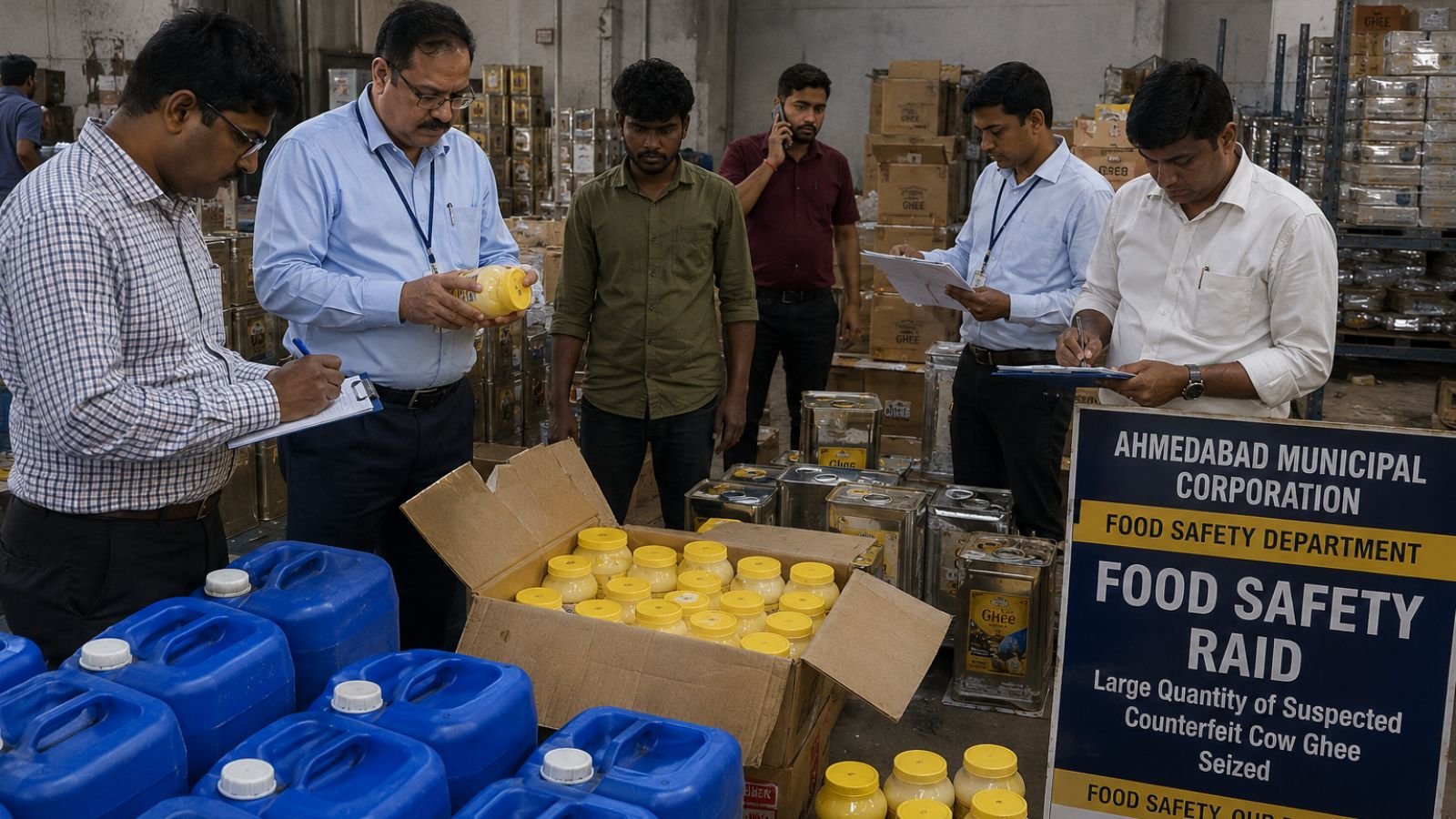
Ahmedabad has witnessed one of its biggest food safety enforcement actions after the Ahmedabad Municipal Corporation (AMC) launched a large scale crackdown on suspected counterfeit cow ghee being distributed across multiple parts of the city. During the operation, AMC food safety department seized approximately 4,850 kilograms of suspected fake cow ghee valued at around ₹31.81 lakh. The action is being viewed as a significant step in protecting consumers from potentially adulterated food products and ensuring compliance with food safety regulations. According to the information provided, the investigation has uncovered a distribution network operating across key industrial and commercial zones of Ahmedabad. Authorities suspect that the seized products may not contain pure dairy based cow ghee and instead may be manufactured using low cost vegetable fat blends designed to resemble genuine cow ghee.
Massive Food Safety Enforcement Drive Conducted by AMC
The Ahmedabad Municipal Corporation food safety department initiated a coordinated enforcement operation targeting suspected violations related to cow ghee manufacturing and distribution. Officials confiscated approximately 4,850 kg of suspected counterfeit cow ghee with an estimated market value of ₹31.81 lakh. The raid focused on locations believed to be involved in the storage, distribution, and movement of the products. Authorities stated that the investigation is examining both product quality concerns and potential violations of food licensing procedures. The operation reflects AMC ongoing efforts to monitor food supply chains and prevent questionable products from reaching consumers.
Locations Targeted During the Enforcement Operation
The investigation reportedly began at the Laxmanbhai Industrial Estate located in the CTM (Indrapuri) area of Ahmedabad. As the inquiry progressed, officials expanded their operations to additional distribution points located in Vatva and Dudheshwar. These locations were identified as important links within the distribution chain connected to the seized stock. The coordinated inspections allowed officials to trace product movement and identify multiple storage and supply points associated with the investigation.
Brands Mentioned During the Investigation
According to the provided information, the seized products were allegedly being distributed under the following brand names:
- Rhythm Cow Ghee (also referred to as Rhydham)
- Vachanamrut Cow Ghee
Authorities are currently examining the seized stock and related documentation as part of the broader investigation. It is important to note that laboratory analysis and regulatory procedures are still ongoing, and official conclusions regarding product composition will depend on the final test results.
Why Authorities Became Suspicious
One of the major factors that reportedly attracted the attention of investigators was a significant pricing discrepancy observed within the supply chain.
| Pricing Comparison | Amount |
|---|---|
| Wholesale price to distributors | ₹330 to ₹350 per kilogram |
| Maximum Retail Price (MRP) on packaging | Approximately ₹700 per kilogram |
Investigators considered this pricing pattern unusual and worthy of further examination. The substantial gap between wholesale and retail values raised concerns regarding manufacturing costs, product sourcing, and overall product authenticity.
Suspected Composition Under Investigation
Authorities suspect that the seized stock may not consist of pure dairy based cow ghee. According to preliminary observations, investigators believe the products could contain processed blends made from inexpensive vegetable fats formulated to imitate the appearance and characteristics of traditional cow ghee. However, officials have emphasized that scientific confirmation can only be established after laboratory testing is completed. Food samples collected during the raids have been forwarded for chemical and quality analysis.
AMC Blocks Entire Stock from Entering the Retail Market
One of the most significant outcomes of the operation is that the entire seized inventory has been prevented from entering the consumer market. AMC officials have reportedly barred the complete 4.8 tonne stock from retail circulation. This precautionary measure ensures that the products remain unavailable for sale while laboratory investigations continue. Such action helps reduce the possibility of potentially non compliant products reaching consumers before verification is completed.
Food Samples Sent for Forensic Testing
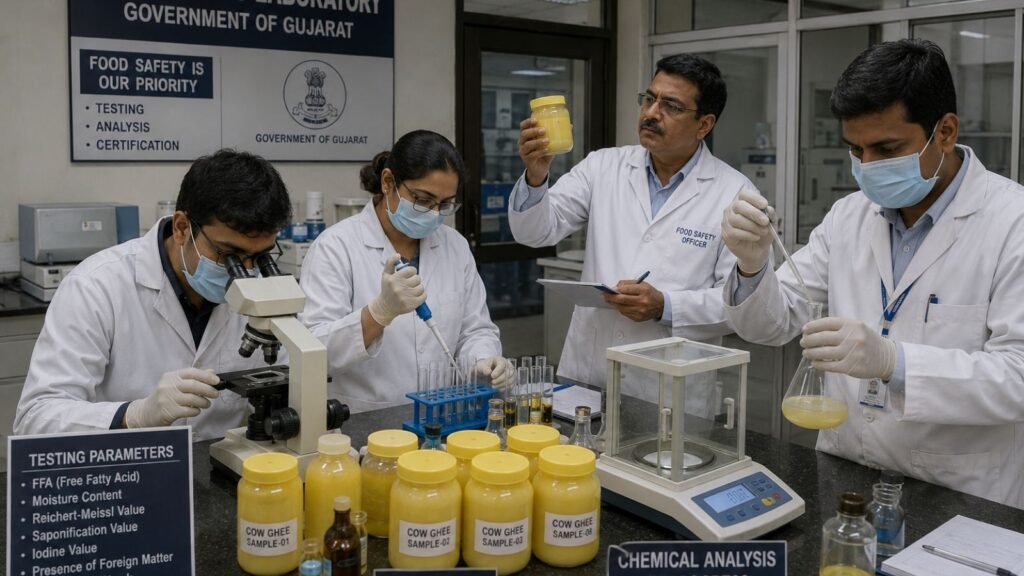
To determine the exact nature of the seized material, AMC officials have initiated scientific testing procedures. Food samples have been collected from the seized stock and sent to government food laboratories for detailed examination.
The testing process is expected to evaluate:
- Product composition
- Purity levels
- Presence of adulterants
- Compliance with food safety standards
Laboratory findings will ultimately determine whether the products meet regulatory requirements or violate food safety laws.
Licensing and Regulatory Investigation Underway
Apart from product testing, investigators are also examining licensing procedures connected to the operation. Officials suspect that regulatory loopholes may have been exploited during business operations. According to the provided information, investigators are reviewing whether the manufacturer benefited from the Food Safety and Standards Authority of India self declaration licensing framework. The inquiry is examining whether licensing conditions were properly followed and whether all required compliance obligations were fulfilled. Authorities have indicated that legal action under the Food Safety and Standards Act, 2006 may be considered after laboratory reports become available.
Why Food Adulteration Cases Matter
Food safety investigations play a critical role in protecting public health. Products such as ghee are widely consumed in Indian households and are commonly used in daily cooking, religious offerings, traditional sweets, festival preparations, and household food preparation. Because of their widespread use, maintaining product quality standards is extremely important. Enforcement actions help authorities monitor supply chains, identify irregularities, and prevent potentially unsafe products from reaching consumers.
Simple Home Ghee Purity Checks Mentioned by Authorities
While official laboratory testing remains the most reliable method of determining product authenticity, the information provided includes several simple household observations that consumers commonly use to assess ghee quality.
| Test | Method | Expected Result for Pure Ghee |
|---|---|---|
| Palm Test | Place small quantity of ghee on palm | Melts naturally at body temperature |
| Heat Test | Heat spoonful of ghee in a pan | Browns relatively quickly |
| Water Test | Place small amount in glass of water | Floats on the surface |
Consumers should remember that these observations are only basic household checks and cannot replace laboratory analysis.
Consumer Awareness Remains Important
The recent seizure highlights the importance of informed purchasing decisions and food quality awareness.
Consumers are encouraged to:
- Purchase products from trusted sources
- Verify packaging details carefully
- Retain purchase bills whenever possible
- Follow updates issued by food safety authorities
- Report suspicious products to relevant regulatory agencies
Awareness, combined with regulatory enforcement, plays a major role in maintaining food quality standards across the market.
Investigation Continues
The AMC food safety crackdown has prevented a large quantity of suspected counterfeit cow ghee from reaching consumers. With 4,850 kg of stock worth approximately ₹31.81 lakh seized, the case has become one of the city significant food safety investigations. Laboratory testing is now expected to provide clarity regarding the composition of the products and determine whether food safety violations have occurred. Meanwhile, authorities continue to examine licensing procedures, supply chain operations, and distribution networks connected to the case. The outcome of the investigation will help determine the next phase of regulatory and legal action while reinforcing the importance of food safety monitoring in protecting consumers.
Frequently Asked Questions
Q1. How much suspected counterfeit cow ghee was seized by AMC in Ahmedabad
A1. The Ahmedabad Municipal Corporation seized approximately 4,850 kilograms of suspected counterfeit cow ghee valued at around ₹31.81 lakh.
Q2. Which brand names were associated with the seized products
A2. The seized products were allegedly being distributed under the brand names Rhythm Cow Ghee (also referred to as Rhydham) and Vachanamrut Cow Ghee.
Q3. What made authorities suspicious about the ghee products
A3. Investigators noticed a significant pricing discrepancy where products were supplied to distributors at ₹330 to ₹350 per kilogram while carrying an MRP of approximately ₹700 per kilogram.
Q4. Where were the raids conducted during the enforcement operation
A4. The investigation began at Laxmanbhai Industrial Estate in CTM (Indrapuri) area, and expanded to additional distribution points in Vatva and Dudheshwar.
Q5. What legal action may be taken after the investigation
A5. Authorities have indicated that legal action under the Food Safety and Standards Act, 2006 may be considered after laboratory reports become available.