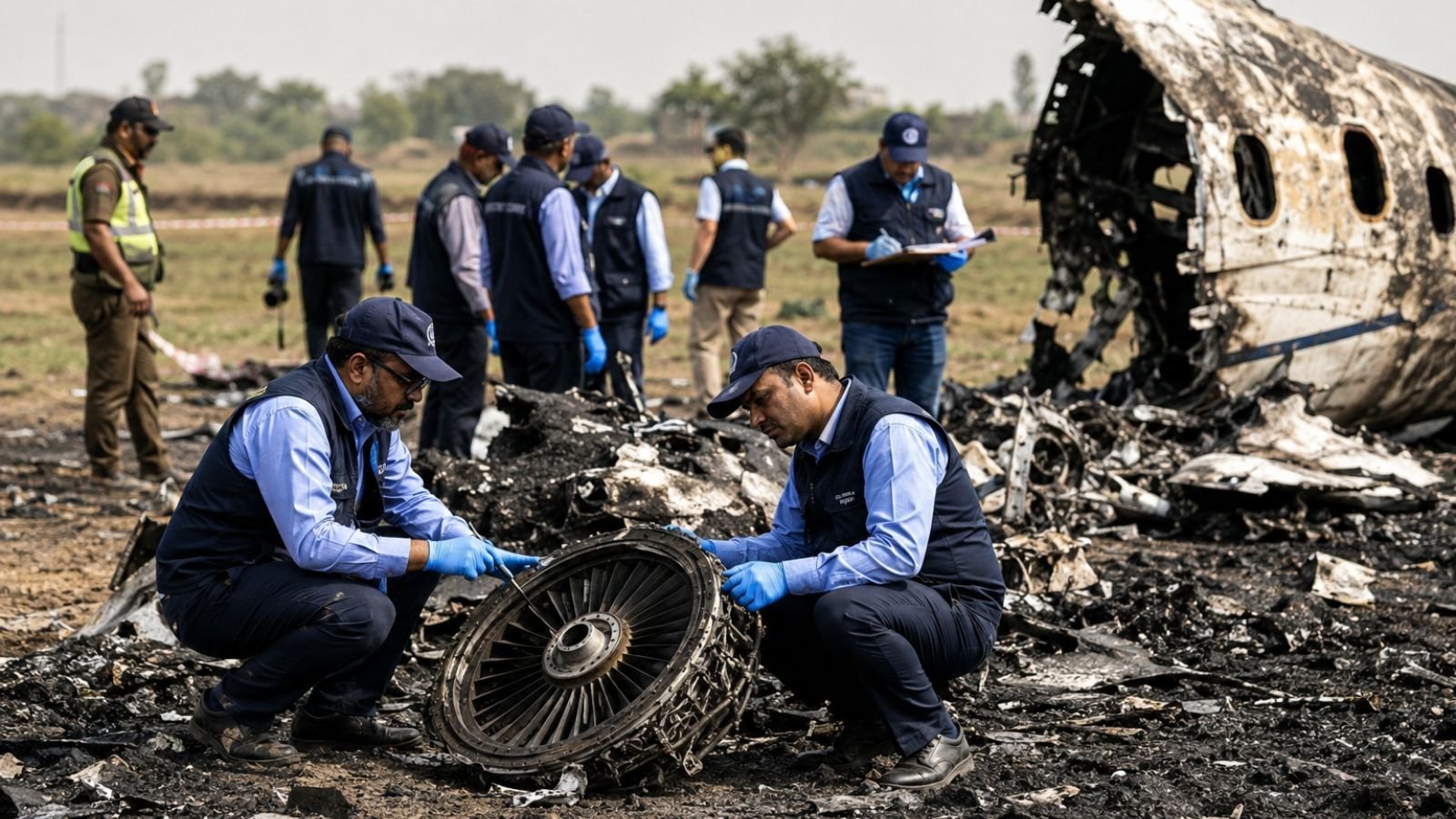
The investigation into the Air India Flight AI171 crash has entered its final phase, according to the latest status update submitted by the Aircraft Accident Investigation Bureau (AAIB) before the Supreme Court of India. In its counter-affidavit, the AAIB informed the apex court that the investigation is currently in the final stage of analysis and is expected to conclude within the next six weeks. The agency also stated that a draft final investigation report is expected in October 2026, subject to the completion of the remaining technical analysis. The update comes ahead of an important Supreme Court hearing regarding petitions seeking an independent, court-monitored investigation into the tragic Air India Flight AI171 crash that occurred on 12 June 2025. This article explains the latest investigation status, progress made by the AAIB, the legal position on confidential cockpit recordings, and the background of the incident.
AAIB Submits Latest Investigation Status to Supreme Court
The Aircraft Accident Investigation Bureau has formally informed the Supreme Court that its investigation is progressing according to both Indian aviation regulations and internationally accepted accident investigation standards. The bureau opposed requests seeking a parallel or court-supervised investigation, stating that its existing inquiry follows the legal framework established under Indian law as well as Annex 13 of the Chicago Convention, which governs international aircraft accident investigations. According to the AAIB, the purpose of the investigation is to determine the causes of the accident and recommend safety improvements rather than assign legal liability.
Current Investigation Status
The investigation has now reached its advanced analytical stage. According to the latest status submitted before the Supreme Court, the AAIB stated that the investigation consists of 66 mandatory investigation steps. Out of these, 49 investigation steps have already been completed. The remaining work primarily involves technical assessment and the integration of findings received from multiple agencies.
Investigators are currently examining several aspects of the accident, including:
- Operational factors
- Technical findings
- Aircraft maintenance records
- Human factors
- Organisational procedures
The bureau is conducting a detailed cross-analysis of all available evidence before preparing its draft report.
Remaining Investigation Work
Although substantial progress has been made, several important technical evaluations are still pending. According to the AAIB, investigators are awaiting data analysis from the Engine Monitoring Unit (EMU), technical coordination with the U.S. National Transportation Safety Board (NTSB), and responses and technical inputs from GE Aerospace. These remaining evaluations are expected to help investigators complete the final technical assessment before drafting the report.
Draft Investigation Report Timeline
The AAIB informed the Supreme Court that the investigation is expected to conclude within approximately six weeks, and a draft investigation report is projected for October 2026. After completion, the draft report will be circulated among accredited international stakeholders. The consultation process is expected to remain open for approximately 30 to 60 days, allowing participating agencies to submit comments before publication of the final report. This consultation process follows internationally accepted aviation accident investigation procedures.
AAIB Legal Position on Cockpit Voice Recorder Recordings
One of the major issues discussed before the Supreme Court concerns the confidentiality of cockpit voice recordings. The AAIB clarified that Indian aviation rules impose a strict legal restriction on publicly releasing or sharing Cockpit Voice Recorder (CVR) audio recordings, airborne images, and other sensitive investigation material. The bureau stated that these restrictions exist to protect the integrity of aircraft accident investigations.
Confidentiality Requirements
According to the AAIB, publicly releasing sensitive investigation material could violate confidentiality provisions, discourage witness cooperation, and affect future aviation safety investigations. The bureau emphasized that accident investigations are intended to improve aviation safety rather than determine civil or criminal responsibility.
Purpose of the Investigation
The AAIB reiterated that its investigation has one primary objective: to improve aviation safety by identifying contributing factors and recommending measures that can help prevent similar accidents in the future. The bureau stated that the investigation is not designed to assign criminal or civil liability.
Protection of Individual Identities
The AAIB also confirmed that the final safety report will protect confidential information, withhold the identities of personnel involved, and present findings in accordance with applicable investigation rules.
Background of the Air India Flight AI171 Crash
Air India Flight AI171, operated by a Boeing 787 Dreamliner, was flying to London when the accident occurred on 12 June 2025, shortly after take-off from Ahmedabad Airport. According to the information presented in the investigation update, the aircraft crashed into the campus of Byramjee Jeejeebhoy Medical College. The accident resulted in 260 total fatalities, including 241 people on board and 19 people on the ground. The incident became one of the most serious aviation accidents in recent Indian aviation history and prompted a comprehensive technical investigation by the Aircraft Accident Investigation Bureau.
Preliminary Investigation Findings
A preliminary factual report released in July 2025 indicated that the aircraft experienced an instantaneous dual-engine loss of thrust after both fuel control switches reportedly moved from the RUN position to the CUTOFF position approximately three seconds after take-off. According to the investigation update, the ongoing inquiry is examining several possible contributing factors, including human factors, pilot training aspects, fuel control switch design mechanisms, and technical systems. The final report is expected to determine the root cause after completing all remaining technical evaluations.
Supreme Court Key Observations
During the ongoing hearings, the Supreme Court of India made several important observations regarding the Air India Flight AI171 crash investigation. The court emphasized that the inquiry must remain transparent, evidence-based, and free from premature conclusions.
No Blame on the Pilot at This Stage
One of the court’s key observations was that no blame can presently be attributed to the pilot-in-command, Captain Sumeet Sabharwal. The bench observed that technical findings are still under examination and criticized media reports that prematurely assigned responsibility before the completion of the official investigation. The court stressed that conclusions should only be drawn after the AAIB completes its scientific investigation.
Court Warns Against a Blame Game
The Supreme Court also directed that the proceedings should not turn into a blame game. The bench observed that the primary purpose of the investigation is to establish factual clarity, improve aviation safety, and provide answers to victims’ families rather than assign responsibility without verified evidence. The court acknowledged the concerns expressed by aviation professionals, pilot associations, and the families of those affected by the accident.
Foreign Reports Will Not Influence Indian Proceedings
The Supreme Court clarified that reports published by foreign media organizations or external technical analyses would not influence India’s judicial process. The court observed that only evidence presented through official investigation channels and legally accepted procedures would be considered during the proceedings. This observation came after concerns were raised regarding reports published before the completion of the official investigation.
Court Seeks Procedural Transparency
The bench also directed the Union Government and the Aircraft Accident Investigation Bureau (AAIB) to place on record the official investigation procedures and timelines being followed. The purpose of this direction is to ensure transparency regarding how the investigation is being conducted while maintaining compliance with aviation investigation rules.
Status of the Request for a Court-Monitored Investigation
Several petitions before the Supreme Court requested the constitution of an independent court-monitored committee to investigate the Air India Flight AI171 accident. However, according to the AAIB’s counter-affidavit, the bureau opposed the creation of a parallel inquiry. The bureau argued that India’s existing statutory investigation framework already provides a complete mechanism for investigating aircraft accidents. According to the AAIB, the investigation is being conducted in accordance with Indian Aircraft Accident Investigation Rules and International Civil Aviation Organization (ICAO) Annex 13 standards. The bureau submitted that establishing another parallel investigation could duplicate work and interfere with internationally accepted investigation procedures.
Supreme Court Yet to Decide
The Supreme Court has not yet replaced the AAIB investigation with an independent court-monitored committee. The court is currently examining the submissions made by the Aircraft Accident Investigation Bureau (AAIB), the Union Government, Safety Matters Foundation, and representatives of the pilot’s family. The matter continues to remain under judicial consideration.
Investigation Focus Moving Forward
As the investigation enters its final analytical stage, investigators are expected to complete the remaining technical evaluations before preparing the draft report. The inquiry continues to examine operational procedures, technical systems, aircraft maintenance, human factors, organisational processes, engine monitoring data, and technical responses received from international agencies. Once these assessments are completed, the bureau will prepare the draft investigation report for international consultation before issuing the final report.
What Happens After the Draft Report
According to the investigation timeline shared before the Supreme Court, remaining technical analysis is expected to conclude within approximately six weeks, a draft report is projected for October 2026, the draft will be circulated among accredited international stakeholders, a 30 to 60 day consultation period will allow participating organisations to submit comments, and after reviewing those comments, the AAIB will prepare and publish the final investigation report.
Conclusion
The latest update on the Air India Flight AI171 crash investigation indicates that the Aircraft Accident Investigation Bureau has entered the final phase of its inquiry. According to the bureau, 49 of the 66 mandatory investigation steps have already been completed, while the remaining work focuses on technical analysis and coordination with international aviation agencies. The Supreme Court has emphasized that no conclusions should be drawn before the investigation is completed. It has also highlighted the importance of avoiding speculation, protecting the integrity of the investigation, and ensuring transparency throughout the process. With the draft investigation report expected in October 2026, the findings are anticipated to provide greater clarity regarding the circumstances of the accident while contributing to future aviation safety improvements.
Frequently Asked Questions
Q1. What is the current status of the Air India Flight AI171 crash investigation?
A1. The investigation has entered its final phase with 49 of 66 mandatory steps completed. The AAIB expects to conclude the investigation within six weeks and release a draft report in October 2026.
Q2. When is the draft investigation report expected?
A2. The draft final investigation report is projected for October 2026, subject to completion of remaining technical analysis.
Q3. What did the Supreme Court observe regarding the pilot’s role in the crash?
A3. The Supreme Court observed that no blame can presently be attributed to the pilot-in-command, Captain Sumeet Sabharwal, and criticized media reports that prematurely assigned responsibility.
Q4. Why is the Cockpit Voice Recorder recording not being made public?
A4. Indian aviation rules impose strict confidentiality provisions on cockpit voice recordings to protect investigation integrity, encourage witness cooperation, and ensure future aviation safety.
Q5. What happens after the draft report is prepared?
A5. The draft report will be circulated among accredited international stakeholders for a 30 to 60 day consultation period before the AAIB publishes the final investigation report.