
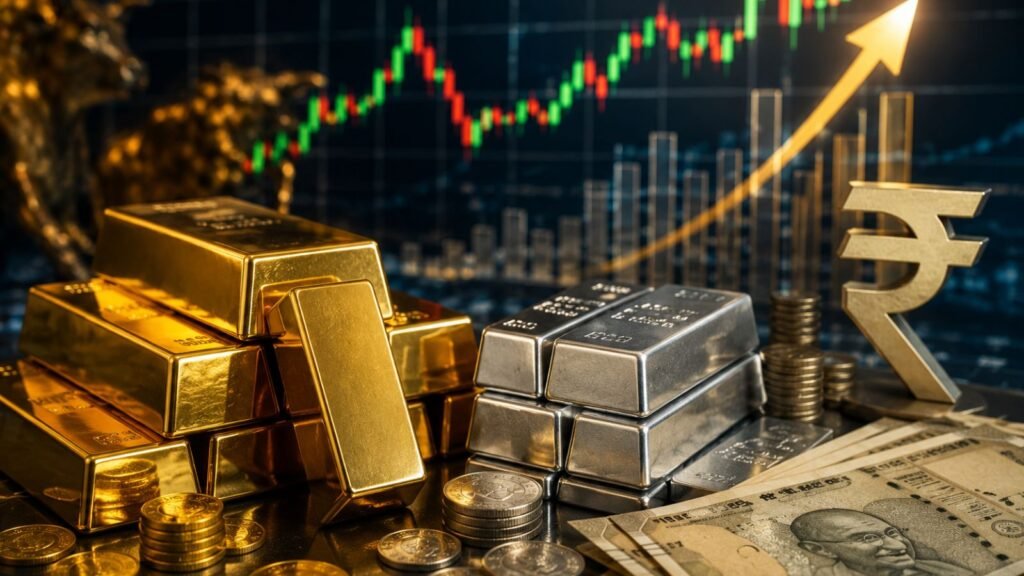
India’s precious metals market witnessed a dramatic shake-up after the Indian government officially increased the effective import duty on gold and silver from 6% to 15%, effective May 13, 2026. The sharp revision, implemented through Ministry of Finance customs notifications, immediately triggered a historic rally in domestic bullion prices while creating volatility across jewelry stocks and commodity markets. The move is part of a broader macroeconomic strategy aimed at defending the weakening Indian rupee, reducing pressure on the current account deficit (CAD), and preserving foreign exchange reserves amid elevated crude oil prices and the ongoing West Asia geopolitical crisis.
India Raises Gold and Silver Import Duty to 15%
- Previous Effective Duty: 6%
- New Effective Duty: 15%
This marks one of the sharpest tax increases seen in India’s bullion import structure in recent years. The decision directly impacts gold imports, silver imports, domestic jewelry pricing, commodity futures, physical bullion demand, retail investors, and jewelry retailers.
Why the Government Increased Gold and Silver Import Duty
- Weakening Indian Rupee: Higher import duties can reduce precious metal imports and help ease pressure on the rupee.
- Rising Current Account Deficit (CAD): India imports large quantities of gold and silver every year. Reducing imports may help narrow the current account deficit.
- Pressure on Foreign Exchange Reserves: The government is attempting to protect foreign exchange reserves amid global economic uncertainty.
- Elevated Crude Oil Costs: Rising oil prices are increasing import bills, creating additional pressure on India’s external finances.
- Ongoing West Asia Crisis: Geopolitical instability has further intensified concerns around currency stability and imported inflation.
New Gold and Silver Duty Structure Explained
- Basic Customs Duty (BCD): Old Rate 5%, New Rate 10%
- Agriculture Infrastructure Cess (AIDC): Old Rate 1%, New Rate 5%
- Total Effective Import Tax: Previous Total 6%, Revised Total 15%
When the 3% Integrated Goods and Services Tax (IGST) is factored into the assessable value, the overall effective tax burden approaches nearly 18.4%. This significantly increases the landed cost of imported bullion.
Immediate Market Reaction After Duty Hike
MCX Gold Prices Exploded
MCX Gold jumped more than ₹9,000, with prices approaching ₹1,62,495 per 10 grams. Futures surged nearly 6% to 7%, making this one of the sharpest single-day rallies seen in the domestic bullion market.
MCX Silver Prices Also Surged
MCX Silver surged over ₹18,000, with prices approaching ₹2,97,192 per kg. Futures exploded nearly 6%, reflecting the direct impact of increased import costs.
Current Gold and Silver Prices in India (As of May 13, 2026)
- MCX Gold (June Futures): ₹1,63,270 per 10 grams (up more than ₹9,700, roughly 6% surge)
- Retail 24K Physical Gold: ₹1,62,550 per 10 grams across major metros
- MCX Silver (July Futures): ₹2,96,270 per kg (up more than ₹17,000, nearly 6% rally)
- Retail Physical Silver: ₹3,10,000 per kg at major retail counters
Domestic Prices Diverge From Global Markets
- International Gold Prices Actually Fell: Global spot gold declined 1% to $4,692.64 per ounce
- International Silver Prices Also Slipped: International silver fell 3.04% to $83.49 per ounce
- Massive Domestic Premium Created: The tax increase has created a large pricing gap between MCX prices in India and international COMEX spot prices.
Jewelry Stocks Witness Sharp Sell-Off
Major listed jewelry companies came under severe pressure after the announcement. Titan Company shares reportedly plunged amid concerns about weaker jewelry demand. Kalyan Jewellers and Senco Gold also declined sharply. Several jewelry stocks fell by as much as 6%. Investors fear that high gold prices may reduce consumer demand, wedding purchases could slow down, retail jewelry volumes may weaken, and consumers may postpone discretionary spending.
Paper Gold Investments Gained Momentum
While physical jewelry stocks struggled, paper gold instruments gained strongly. Gold ETFs closed up to 6.5% higher. Investors are reportedly shifting away from physical gold purchases toward more liquid and tax-efficient alternatives such as Sovereign Gold Bonds (SGBs), Electronic Gold Receipts (EGRs), Gold ETFs, and Silver ETFs.
Why Existing Gold Holders Benefit
People already holding physical gold may benefit from the sudden price jump. Because imported bullion now costs significantly more, gold bars, coins, and jewelry already held domestically have effectively appreciated in value. Domestic prices are now trading at a premium compared to international markets.
Consumer Buying Behavior Expected to Change
Wedding purchases may reduce temporarily. Consumers may recycle old jewelry. New discretionary buying may slow down. The India Bullion and Jewellers Association (IBJA) reportedly expects temporary down-sizing in jewelry purchases.
Government Appeal to Reduce Non-Essential Gold Buying
Prime Minister Narendra Modi’s public appeal urging people to avoid unnecessary gold purchases to help protect India’s foreign exchange reserves reflects broader concerns around rising import dependency.
Increased Smuggling Risks Raise Concerns
The steep 9% tax jump may revive illegal grey-market activities. Industry experts reportedly fear increased bullion smuggling, parallel market growth, and informal trading activity.
Investors Advised to Remain Careful
Investors purchasing physical bullion should buy only from organized sellers, ensure complete documentation, avoid unverified channels, and maintain tax-compliant purchase records.
Gold Loan NBFCs May Benefit
Gold-financing companies such as Muthoot Finance and Manappuram Finance may benefit from rising gold prices. As gold prices rise, the collateral value of pledged gold also increases, potentially strengthening the asset base of gold loan businesses.
Strong Medium-Term Outlook for Precious Metals
Despite short-term demand concerns, the broader outlook for gold and silver remains strong. Factors supporting bullion prices include geopolitical uncertainty (ongoing Middle East crisis), global inflation, shipping and trade disruptions, and safe-haven demand during unstable economic periods.
Impact on Indian Consumers
Wedding Buyers: May reduce jewelry budgets, delay purchases, prefer lighter jewelry sets, or recycle existing family gold.
Retail Investors: May increasingly move toward digital gold, ETFs, Sovereign Gold Bonds, and paper silver products.
Jewelry Retailers: May face lower showroom demand, slower inventory movement, margin pressures, and reduced discretionary purchases.
Conclusion
India’s decision to sharply raise the effective import duty on gold and silver from 6% to 15% from May 13, 2026, has triggered one of the biggest recent disruptions in the domestic bullion market. The move immediately pushed MCX gold and silver prices to record highs while creating pressure on jewelry stocks and retail consumption. The government introduced the measure to protect the rupee, control the current account deficit, and preserve foreign exchange reserves amid global geopolitical and economic uncertainty. Despite short-term disruption, precious metals continue to retain strong safe-haven appeal amid ongoing global uncertainty.
Frequently Asked Questions
Q1. What is the new effective import duty on gold and silver in India?
A1. The effective import duty has been increased from 6% to 15% effective May 13, 2026.
Q2. How much did MCX gold prices surge after the duty hike?
A2. MCX gold jumped more than ₹9,000, approaching ₹1,62,495 per 10 grams, a surge of nearly 6% to 7%.
Q3. Why did the government increase import duties on precious metals?
A3. To defend the weakening rupee, reduce pressure on the current account deficit, and preserve foreign exchange reserves amid global uncertainty.
Q4. How did jewelry stocks react to the duty hike?
A4. Major jewelry stocks including Titan, Kalyan Jewellers, and Senco Gold declined sharply, with some falling by as much as 6%.
Q5. What alternatives are investors considering instead of physical gold?
A5. Investors are shifting toward Sovereign Gold Bonds (SGBs), Electronic Gold Receipts (EGRs), Gold ETFs, and Silver ETFs.