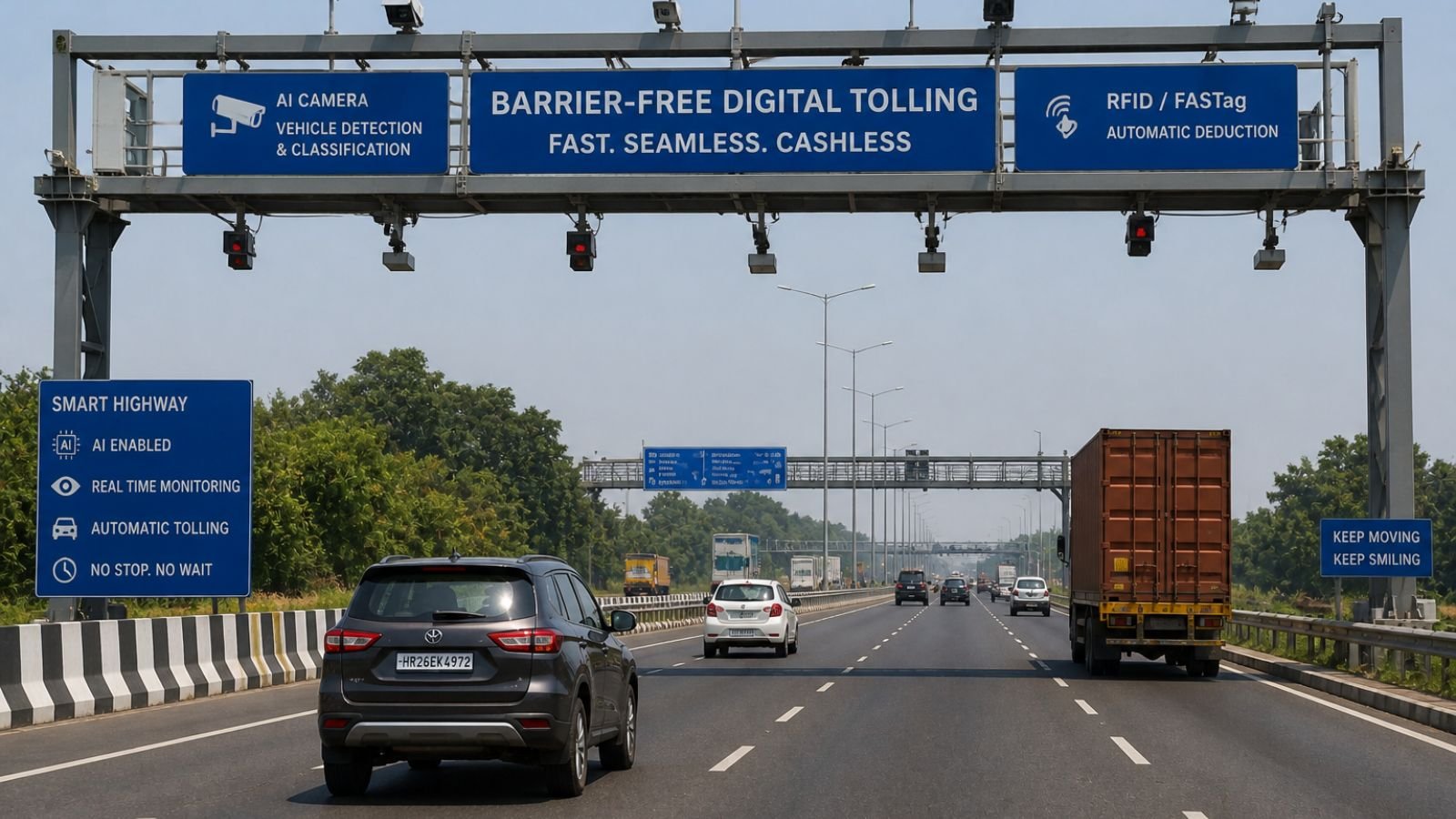
India has taken a major leap in highway infrastructure with the launch of its first Multi-Lane Free Flow (MLFF) toll system in Surat, Gujarat. This new barrier-free tolling technology eliminates traditional toll booths and introduces a fully digital, high-speed toll collection system designed to reduce congestion and improve travel efficiency.
The system officially went live on May 1, 2026, at the Choryasi (Kamrej) toll plaza on NH-48, marking a significant transformation in how tolls are collected across India.
What is the MLFF Toll System?
The Multi-Lane Free Flow (MLFF) system is an advanced digital tolling solution that allows vehicles to pass through toll points without stopping. Unlike traditional toll plazas with boom barriers and queues, MLFF uses “invisible tolling” technology to automatically detect vehicles and deduct toll charges in real time.
This innovation aims to reduce waiting time, fuel consumption, and pollution caused by long queues at toll booths.
Key Technology Behind Surat’s MLFF Toll Plaza
The Choryasi toll plaza uses cutting-edge technology to ensure seamless toll collection even at high speeds.
- ANPR Cameras: AI-powered Automatic Number Plate Recognition cameras capture high-resolution images of vehicle number plates to identify vehicles instantly.
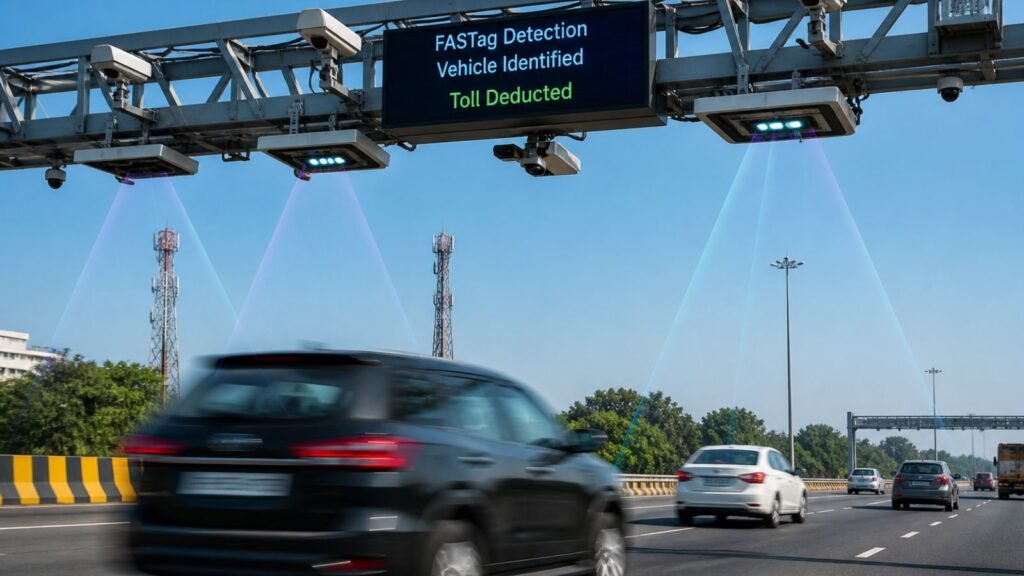
- RFID FASTag Readers: Advanced scanners read FASTag stickers across multiple lanes simultaneously without requiring vehicles to slow down.
- Sensor-Based Tracking System: The system includes LiDAR, radar, and antenna-based sensors to track vehicle speed, classification, and movement accurately, even at speeds up to 150 km/h.
These technologies work together to ensure accurate and efficient toll deduction without physical interaction.
How the Barrier-Free Toll System Works
The MLFF toll system Surat 2026 follows a simple automated process:
As a vehicle passes under the overhead gantry, FASTag is instantly detected. The toll amount is automatically deducted from the linked bank account. If FASTag is missing or inactive, the system uses ANPR cameras to identify the vehicle via the VAHAN database. An electronic notice is then sent to the vehicle owner for payment.
This ensures that every vehicle is accounted for, whether or not it has a functioning FASTag.
72-Hour Rule for Toll Payment
To manage non-payments, a new 72-hour payment rule has been introduced:
- If toll deduction fails, the user receives an SMS or email notice.
- The vehicle owner has 72 hours to pay the original toll amount without penalty.
- If unpaid after 72 hours, the toll charge is doubled.
- Continued non-payment beyond 15 days leads to blacklisting in the VAHAN database, which can block RC renewal or fitness certificates.
This rule ensures timely payments while offering a short grace period.
Updated Toll Rates at Choryasi Toll Plaza (NH-48)
The revised toll rates under the MLFF system at this barrier-free toll plaza are as follows:
- Light Motor Vehicles (Car/Jeep/Van): Single Journey ₹125, Return Journey ₹185, Monthly Pass (50 trips) ₹4,150
- Light Commercial Vehicles (LCV/Mini Bus): Single Journey ₹200, Return Journey ₹300, Monthly Pass ₹6,705
- Bus/Truck (2-Axle): Single Journey ₹420, Return Journey ₹630, Monthly Pass ₹14,050
- 3-Axle Vehicles: Single Journey ₹460, Return Journey ₹690, Monthly Pass ₹15,330
- 4–6 Axle Vehicles: Single Journey ₹660, Return Journey ₹990, Monthly Pass ₹22,035
- Oversized Vehicles (7+ Axle): Single Journey ₹805, Return Journey ₹1,205, Monthly Pass ₹26,825
Local Resident Benefit: Residents within a 20 km radius can avail a monthly pass for approximately ₹360.
Penalty Rule: Vehicles without valid FASTag or sufficient balance may be charged double toll fees.
Impact of the New Toll System
The MLFF system is already showing significant benefits:
- Handles nearly 25,000 vehicles daily
- Reduces travel time by eliminating stops
- Saves fuel and lowers emissions
- Improves highway traffic flow
This system is expected to enhance overall commuter experience on busy national highways.
Nationwide Expansion Plan
The Surat MLFF toll plaza is currently a pilot project. Based on its success, the National Highways Authority of India (NHAI) plans to convert over 1,050 toll plazas into barrier-free systems by the end of 2026. This marks the beginning of a nationwide transformation in toll collection.
FASTag Balance Check Methods
To avoid penalties or notices, users should regularly check their FASTag rules India compliance using the following methods:
- My FASTag App: Download the official app and enter your vehicle number to check wallet balance.
- Missed Call Service: Give a missed call to +91-8884333331 from your registered number to receive balance details via SMS.
- WhatsApp Banking: Certain banks allow balance checks via WhatsApp by sending “Hi” to 95555-55555.
- SMS Alerts: Check the last toll deduction SMS from your bank for updated balance information.
Why This Change is Important
The introduction of MLFF tolling represents a major step toward a smarter, digital India. It reduces dependence on manual systems and aligns with global standards in highway management.
For daily commuters, it means faster travel and fewer delays. For the government, it ensures better revenue tracking and transparency.
Conclusion
The launch of India’s first barrier-free MLFF toll plaza in Surat is a game-changing development in road infrastructure. With advanced technology, automated toll collection, and strict payment rules, the system promises efficiency, transparency, and convenience for millions of travelers.
As India moves toward expanding this system nationwide, understanding how it works and staying compliant with FASTag rules will be essential for all vehicle owners.
Frequently Asked Questions
Q1. What is the MLFF toll system?
A1. MLFF (Multi-Lane Free Flow) is an advanced digital tolling system that allows vehicles to pass through toll points without stopping using ANPR cameras and RFID FASTag readers.
Q2. Where is India’s first barrier-free toll plaza located?
A2. India’s first MLFF toll plaza is at Choryasi (Kamrej) on NH-48 in Surat, Gujarat, launched on May 1, 2026.
Q3. What is the 72-hour payment rule for tolls?
A3. If toll deduction fails, users have 72 hours to pay the original toll amount without penalty. After 72 hours, the toll is doubled, and non-payment beyond 15 days leads to VAHAN blacklisting.
Q4. What is the toll rate for a car at Choryasi toll plaza?
A4. The single journey toll for light motor vehicles (car/jeep/van) is ₹125, with a return journey toll of ₹185.
Q5. How can I check my FASTag balance?
A5. You can check your FASTag balance via the My FASTag app, missed call to +91-8884333331, WhatsApp banking, or SMS alerts from your bank.