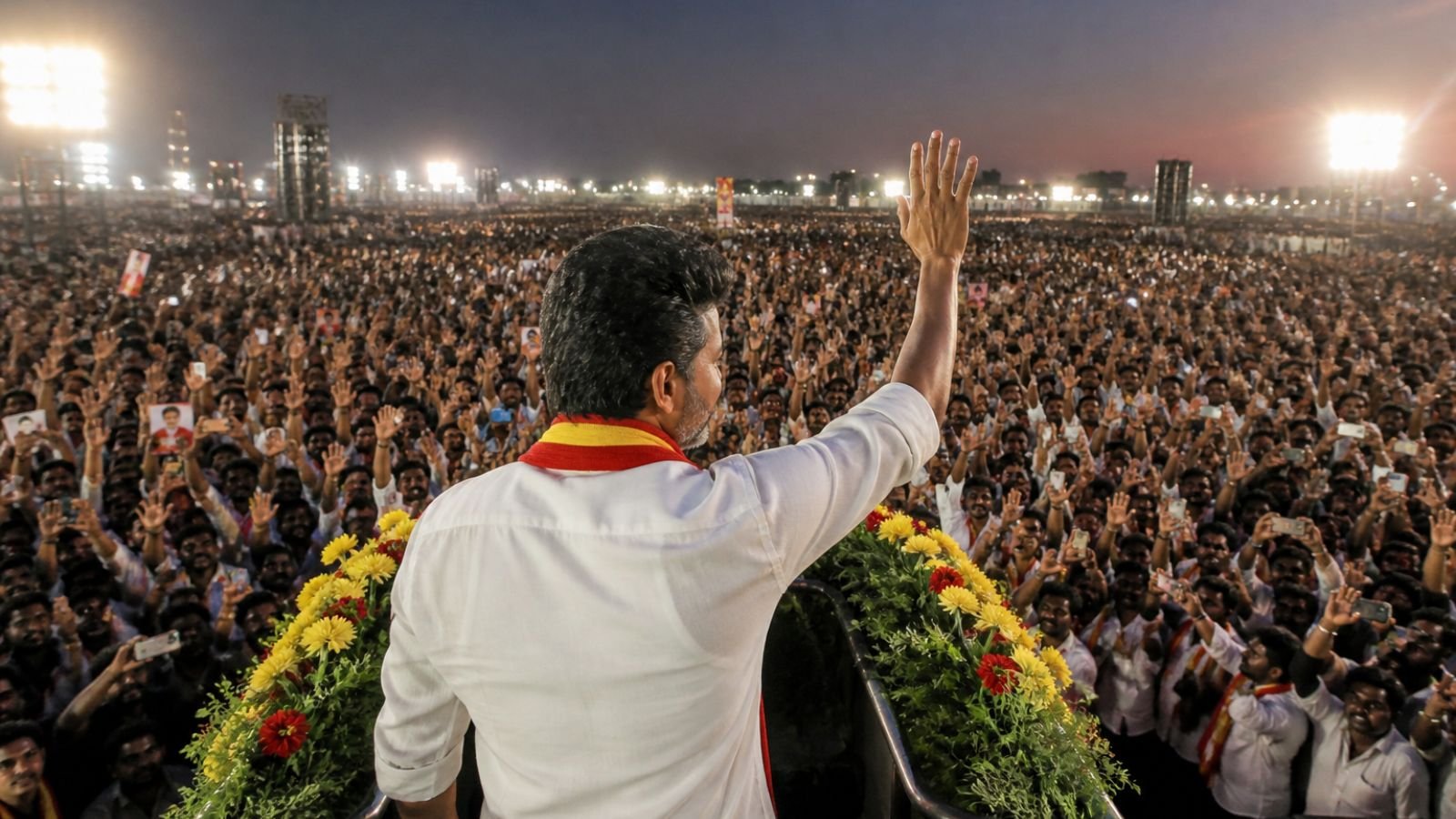
In a major political shift in Tamil Nadu, actor-turned-politician Vijay has emerged as a powerful force in the 2026 Assembly elections through his party Tamilaga Vettri Kazhagam. As of May 4, 2026, counting trends indicate that TVK is leading in more than 100 seats, placing it in a strong position to form the government or play a decisive role in power formation.
Election 2026 Performance
Tamilaga Vettri Kazhagam has delivered a remarkable debut performance in its first major electoral contest.
- TVK is leading in 109 seats out of the 234-member assembly.
- The party has secured an estimated vote share between 32 percent and 34 percent.
- Vijay achieved victories in two constituencies, Perambur in Chennai and Tiruchirappalli East.
- In a significant political upset, TVK candidate VS Babu defeated sitting Chief Minister MK Stalin in Kolathur.
This performance has positioned TVK as the single largest political force in the state.
Final Results Table: Tamil Nadu Election 2026
| Party | Leads Wins out of 234 | Status |
|---|---|---|
| TVK | 109 | Emerging as the single largest party |
| AIADMK | 61 | Leading opposition |
| DMK | 47 | Third position |
Vijay’s victories in Perambur and Tiruchirappalli East have strengthened his leadership image and placed him as the likely Chief Minister.
About Tamilaga Vettri Kazhagam
Tamilaga Vettri Kazhagam was founded on February 2, 2024, in Panaiyur, Chennai. The name translates to Tamil Nadu Victory Federation.
The party follows a centre-left ideology focusing on secular social justice, equality, and administrative transparency.
TVK has positioned BJP as its ideological opponent and DMK as its direct political rival. The party chose to contest all 234 seats independently without alliances.
The party symbol is the whistle. Its flag features dark red and yellow bands with two war elephants and the Vagai flower, symbolizing victory in Tamil culture.
Key Manifesto Promises
TVK’s campaign focused strongly on youth, women, and marginalized communities.
- Women Welfare: Monthly financial assistance of 2500 rupees for female heads of households and free travel on government buses.
- Education: Removal of the NEET exam and establishment of 100 Kamarajar Special Residential Schools.
- Governance: Creation of an Artificial Intelligence Ministry and introduction of doorstep delivery of government services through a digital platform.
- Employment: 75 percent reservation for local residents in both private and public sector jobs.
Vijay Personal Profile and Wealth
Vijay officially stepped away from cinema after his 69th film Jana Nayagan released in early 2026, choosing to focus fully on public service.
According to his election affidavit:
- Net worth is estimated between 603 crore and 625 crore rupees.
- Annual income for 2024 to 2025 is 184.53 crore rupees.
- Assets include multiple luxury cars such as BMW i7 and Lexus models, along with over 883 grams of gold.
100 Day Action Plan Breakdown
Following the election victory, TVK announced a structured 100 day action plan focusing on immediate relief and long-term governance reforms.
Immediate Welfare Relief: Days 1 to 30
The first phase focuses on direct public support.
- Launch of 2500 rupees monthly financial aid for women.
- Free bus travel for women across the state.
- Implementation of 200 units of free electricity for households.
- Distribution of free LPG cylinders under a yearly quota system.
- Marriage assistance including gold and saree support for underprivileged women.
Governance and Youth Focus: Days 31 to 60
The second phase emphasizes transparency and youth empowerment.
- Launch of Vetri TN Super App for doorstep delivery of over 500 government services.
- Monthly unemployment allowance of 4000 rupees for graduates and 2500 rupees for diploma holders.
- Establishment of India’s first Ministry of Artificial Intelligence.
- Implementation of a Recruitment Transparency Act to improve hiring systems.
Infrastructure and Agriculture: Days 61 to 100
The final phase targets rural development and healthcare.
- Full cooperative loan waiver for farmers owning less than five acres.
- Launch of 3000 Makkal Nala Nilayam clinics across the state.
- Introduction of a 25 lakh rupees family health insurance scheme.
- Start of development work for 100 Kamarajar Special Residential Schools.
Political Impact and What Lies Ahead
TVK’s strong debut has disrupted the traditional political structure in Tamil Nadu. With AIADMK and DMK trailing behind, the state is witnessing a major transformation in leadership dynamics.
The close seat numbers suggest that final government formation will depend on alliances or continued lead conversion. However, Vijay’s growing influence and public support clearly indicate a new political chapter in the state.
Conclusion
The 2026 Tamil Nadu Assembly elections have marked a turning point with Tamilaga Vettri Kazhagam emerging as a dominant force. Vijay’s transition from cinema to politics has translated into real electoral success, backed by a focused manifesto and strong voter connect.
With a detailed 100 day plan already in place, the coming weeks will determine how effectively these promises are implemented and how the new leadership shapes the future of Tamil Nadu.
Frequently Asked Questions
Q1. How many seats did TVK win in the Tamil Nadu Election 2026?
A1. TVK is leading in 109 seats out of the 234-member assembly, emerging as the single largest party.
Q2. Who did Vijay defeat in the election?
A2. Vijay won in two constituencies, Perambur in Chennai and Tiruchirappalli East. Additionally, TVK candidate VS Babu defeated sitting Chief Minister MK Stalin in Kolathur.
Q3. What are the key manifesto promises of TVK?
A3. Key promises include monthly financial assistance of 2500 rupees for women, removal of NEET, creation of an AI Ministry, and 75 percent local reservation in jobs.
Q4. What is Vijay’s estimated net worth according to his election affidavit?
A4. Vijay’s net worth is estimated between 603 crore and 625 crore rupees.
Q5. What are the three phases of TVK’s 100 day action plan?
A5. The three phases are Immediate Welfare Relief (Days 1 to 30), Governance and Youth Focus (Days 31 to 60), and Infrastructure and Agriculture (Days 61 to 100).