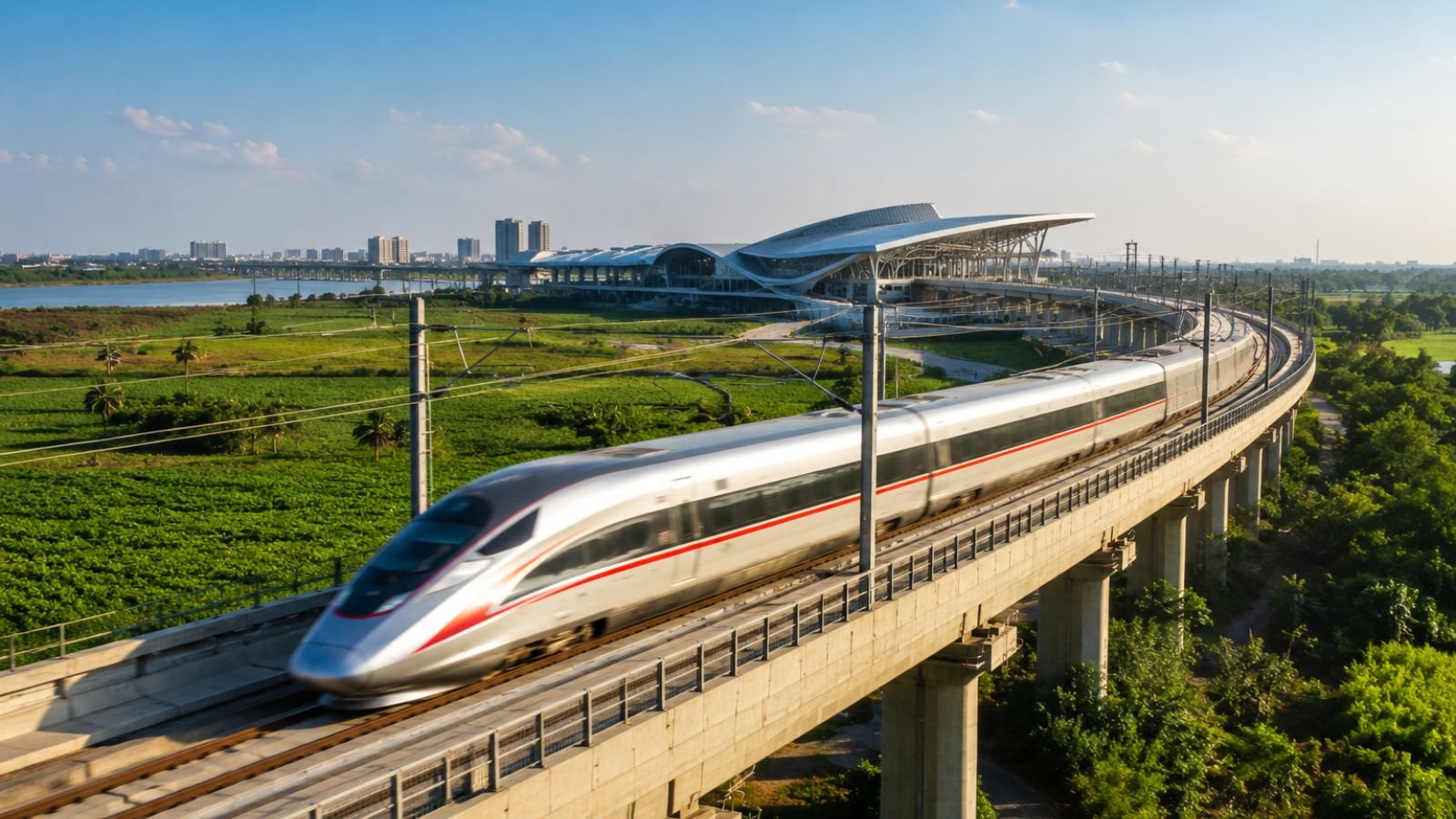
The Mumbai Ahmedabad High-Speed Rail (MAHSR) project, popularly known as the Mumbai Ahmedabad Bullet Train Project, is one of India’s largest transportation infrastructure projects. The high-speed rail corridor is currently in an advanced stage of construction, with its first operational phase officially scheduled to launch on August 15, 2027. Designed to transform intercity travel between Maharashtra and Gujarat, the project aims to provide faster, safer, and more efficient transportation while strengthening economic growth, tourism, and regional connectivity. Once fully completed, the bullet train will significantly reduce travel time between Mumbai and Ahmedabad and introduce world-class high-speed rail technology in India. This guide explains the latest progress of the Mumbai Ahmedabad Bullet Train Project, including its route, stations, construction updates, project cost, land acquisition, engineering milestones, and expected operational timeline.
Mumbai Ahmedabad Bullet Train Project Overview
The Mumbai Ahmedabad High-Speed Rail corridor is India’s first dedicated high-speed rail project. The project includes a 508-kilometre dedicated high-speed railway corridor connecting Mumbai in Maharashtra with Ahmedabad in Gujarat. The corridor has been specially designed for high-speed passenger trains and will operate separately from conventional railway lines. The project is being executed by the National High Speed Rail Corporation Limited (NHSRCL), which is responsible for planning, construction, and implementation of the corridor.
Stations on the Bullet Train Route
The corridor will include 12 modern stations located at:
- Mumbai (BKC)
- Thane
- Virar
- Boisar
- Vapi
- Bilimora
- Surat
- Bharuch
- Vadodara
- Anand
- Ahmedabad
- Sabarmati
These stations are expected to improve connectivity between major industrial, commercial, and urban centres across Maharashtra and Gujarat. Four stations—Virar and Thane in Maharashtra, and Surat and Sabarmati in Gujarat—are being developed as model stations with direct input from Japanese urban planning experts. The Sabarmati station is being developed as a multimodal transport hub, integrating the bullet train with metro, BRTS, and conventional railway services.
Design Speed and Travel Time
The high-speed rail system has been engineered for an operating speed of 320 km/h, with a design speed of 350 km/h. Once operational, the travel time between Mumbai and Ahmedabad is expected to reduce from more than six hours to approximately two hours and seven minutes, making long-distance travel significantly faster.
Project Status and Key Metrics
The Mumbai Ahmedabad Bullet Train Project has achieved significant progress across multiple areas of construction and development.
| Aspect | Current Status | Construction Progress | Next Milestone | Expected Benefits |
|---|---|---|---|---|
| Overall Project | Advanced stage of construction | 69% financial progress, ₹86,939 crore expenditure | August 15, 2027: First phase launch | Transform intercity travel, introduce high-speed rail technology in India |
| Route and Stations | 508 km corridor, 12 stations identified | 100% land acquisition completed; station construction advancing | Surat-Bilimora section launch | Connect major industrial, commercial, and urban centres across Maharashtra and Gujarat |
| Civil Infrastructure | Pier work, viaducts, bridges under construction | 443+ km piers completed, 349 km viaducts launched, 17 river bridges built | Track installation completion | Enable high-speed train operations at 320 km/h |
| Tunnels | India’s first 21 km undersea tunnel | 5+ km excavated using NATM; 7 mountain tunnels under construction | Tunnel breakthrough and completion | Create seamless connectivity between Mumbai BKC and Shilphata |
| Rolling Stock | B28 trainsets under development | First trainset expected by early 2027 | Deployment on Surat-Bilimora section | Provide indigenous high-speed train operations at 280 km/h |
| Station Development | Gujarat stations nearing superstructure completion | Active yard development at Ahmedabad and Surat depots | Full station completion | Offer world-class passenger facilities with architectural identity |
| Legal and Financial | LARRA ruling contested before Gujarat High Court | Land compensation case pending | Gujarat High Court hearing on August 5 | Resolve land compensation matters and mitigate potential ₹40,000 crore financial burden |
| Full Corridor | Phased expansion underway | Surat-Bilimora section ready; Gujarat viaduct section progressing | December 2029: Full 508 km corridor operational | Reduce Mumbai-Ahmedabad travel time to 2 hours 7 minutes |
Latest Cost-Related Developments
The Mumbai Ahmedabad Bullet Train Project represents one of India’s biggest infrastructure investments. The estimated project cost is approximately ₹1.08 lakh crore (around 17 billion US dollars). A major portion of the funding comes through an Official Development Assistance (ODA) loan provided by the Japan International Cooperation Agency (JICA).
Construction has continued to progress steadily across multiple sections of the corridor. Overall financial progress has crossed 69 percent, with project expenditure reaching approximately ₹86,939 crore as of February 2026. This reflects significant advancement in civil construction, infrastructure development, and system installation activities.
Alongside construction progress, the project is also facing an important legal matter related to land compensation. The project authority is currently contesting an adverse ruling issued by the Land Acquisition, Rehabilitation and Resettlement Authority (LARRA) before the Gujarat High Court. Enhanced land compensation structures and accumulated interest could create a potential financial burden of nearly ₹40,000 crore.
Construction Progress
Construction activities are progressing across multiple parts of the corridor with major civil works already completed in several sections.
- Civil engineering teams have completed more than 443 kilometres of pier work
- Around 349 kilometres of overhead viaducts have already been successfully launched, representing one of the largest completed components of the project
- Construction teams have completed 17 major river bridges and 13 heavy steel superstructure bridges
- Workers have laid approximately 374 track-kilometres, equivalent to 187 route-kilometres, using reinforced concrete (RC) track bed technology specially designed for high-speed rail operations
System Integration and Tunnels
Installation of railway systems is advancing alongside civil construction.
- More than 7,700 overhead electrification (OHE) masts installed
- Around 5.7 lakh noise reduction barriers fully installed along different sections of the corridor
These systems are essential for safe, efficient, and environmentally responsible operation of high-speed trains.
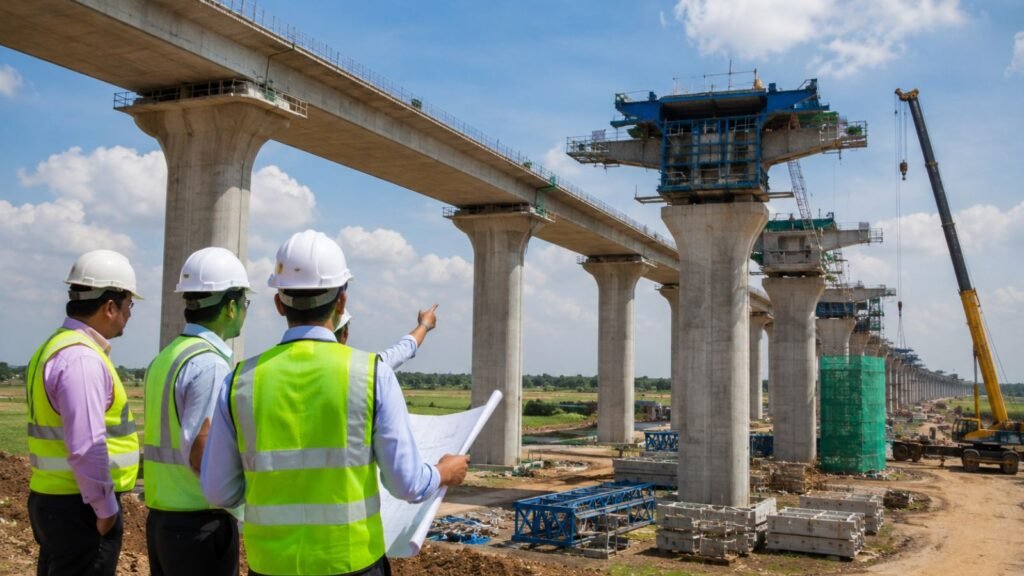
One of the most significant engineering features is the construction of India’s first 21-kilometre underground and undersea shield tunnel connecting Mumbai’s Bandra-Kurla Complex (BKC) terminal with Shilphata. Construction teams have already excavated more than five kilometres using the New Austrian Tunnelling Method (NATM). Additionally, there are seven mountain tunnels in the project, with breakthroughs already achieved for multiple tunnels in Palghar district.
Station Development
Construction of station infrastructure is also moving forward. Superstructure fabrication is nearing completion across stations in Gujarat. The design of the Surat station draws inspiration from the city’s world-renowned diamond industry, incorporating diamond geometries in its elevation and ceiling. Ahmedabad’s station draws on the jaali pattern of the Sidi Saiyyed mosque, one of the city’s most recognised architectural landmarks. At the same time, active yard development work is underway at the Ahmedabad and Surat rolling stock maintenance depots, which will support maintenance and servicing of bullet train operations.
Rolling Stock Development
The initial phase of operations is expected to deploy India’s indigenous B28 trainsets, manufactured by BEML at its Aditya facility in Bengaluru. These trainsets are designed to operate at speeds of up to 280 km/h during the early phase. They will serve until the next-generation Japanese Shinkansen trainsets complete localization and deployment for future phases of the project. The first B28 high-speed train is expected to be ready by early 2027, following which it will be moved to the Surat depot for testing and trial runs on the corridor.
Expected Project Timeline
Construction work is progressing in phases, with passenger operations planned in stages before the complete corridor becomes operational.
- The Surat-Bilimora section, covering approximately 47 to 50 kilometres, is in an advanced stage of completion, with civil works and track-bed laying fully completed
- The first operational phase of the Mumbai Ahmedabad Bullet Train Project is officially scheduled to begin on August 15, 2027
- Following the successful launch of the first phase, additional sections across Gujarat are expected to become operational in stages, extending from Vapi to Surat, then Vapi to Ahmedabad, and progressively towards Thane and Mumbai
- The complete 508-kilometre Mumbai Ahmedabad High-Speed Rail Corridor is currently scheduled to become fully operational by December 2029
Benefits for Gujarat
The Mumbai Ahmedabad Bullet Train Project is expected to provide long-term economic and infrastructure benefits for Gujarat. With multiple stations located across the state, the project will improve regional connectivity while supporting business, tourism, and industrial development. The high-speed rail corridor is expected to strengthen the economic connection between Surat, Vadodara, and Ahmedabad, creating a more integrated economic region. Better connectivity may help promote heritage tourism, business tourism, domestic travel, and regional tourism growth.
Conclusion
The Mumbai Ahmedabad Bullet Train Project Update 2026 highlights the remarkable progress made on India’s first high-speed rail corridor. From achieving significant civil construction milestones and advancing station development to tunnel excavation and system installation, the project has entered an important phase of execution. The first operational section is officially scheduled to launch on August 15, 2027, while the full 508-kilometre corridor is expected to become operational by December 2029. Once completed, the project is expected to transform passenger travel between Mumbai and Ahmedabad, strengthen Gujarat’s economic growth, support tourism, and introduce world-class high-speed rail technology to India.
Frequently Asked Questions
Q1. When will the Mumbai Ahmedabad Bullet Train first section become operational?
A1. The first section between Surat and Bilimora is scheduled to launch on August 15, 2027.
Q2. How many stations will the Mumbai Ahmedabad Bullet Train corridor have?
A2. The corridor will have 12 stations including Mumbai (BKC), Thane, Virar, Boisar, Vapi, Bilimora, Surat, Bharuch, Vadodara, Anand, Ahmedabad, and Sabarmati.
Q3. What is the operational speed of the Mumbai Ahmedabad Bullet Train?
A3. The bullet train will operate at a speed of 320 km/h, with a design speed of 350 km/h.
Q4. What is the expected travel time between Mumbai and Ahmedabad on the bullet train?
A4. The travel time will be reduced to approximately 2 hours and 7 minutes, compared to over 6 hours by conventional trains.
Q5. When will the complete Mumbai Ahmedabad Bullet Train corridor become operational?
A5. The full 508-kilometre corridor is scheduled to become fully operational by December 2029.